How Do 3D Glasses Work? Every Type, and What It Works With
How we researched this: written by Owl3D from published sources, all 27 listed at the end.
Short answer
3D glasses work by making sure each eye sees a different image; your brain fuses the two into one picture with depth. There are four kinds, anaglyph (red-cyan), polarized, active shutter and spectral, and each works only with a screen or projector built for it.
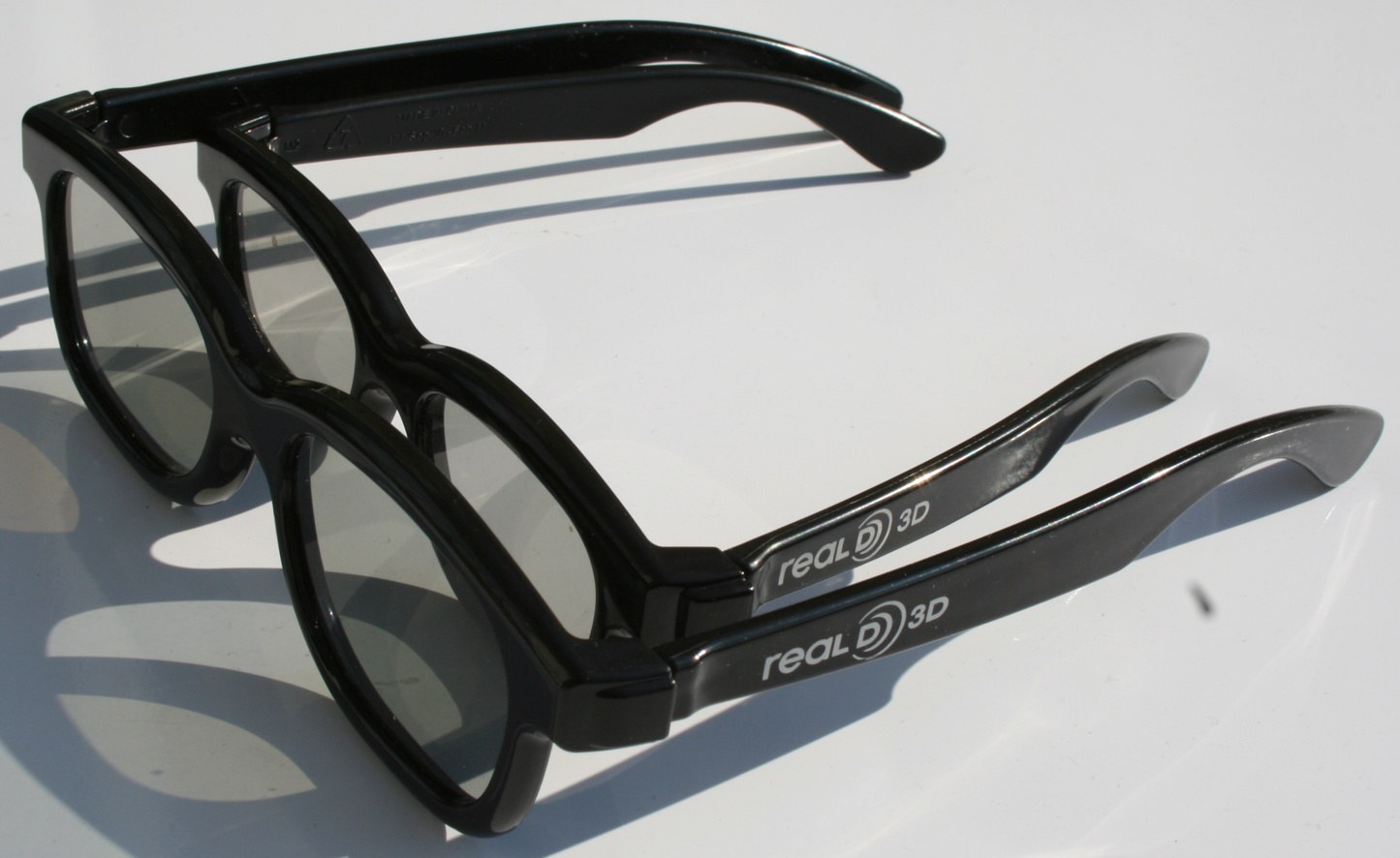
Polarized glasses from a RealD 3D cinema, one of the four kinds: an adult pair and a child's pair. Photo: Gmhofmann, CC BY-SA 3.0, via Wikimedia Commons.
Key takeaways
- The four kinds are not interchangeable, and red-cyan glasses are the only kind that work on an ordinary screen; see which glasses work with which screen.
- Of cinema glasses, only RealD pairs work at home, and only with a passive 3D TV; see cinema glasses at home.
- Prices run from $0.75 a pair for paper red-cyan glasses to $29 to $40 a pair for DLP Link shutter glasses; see what they cost.
- A glasses-free 3D display needs no 3D glasses, and the Owl3D Shift, one such display, works with your prescription glasses on; see 3D without glasses.
Quick picks
- Ordinary TV, monitor, phone or printanaglyph (red-cyan) glasses, with anaglyph content
- Passive 3D TV, such as LG Cinema 3Dcircular polarized glasses
- Samsung active 3D TVthe active shutter model listed for your TV's series
- Sony 3D TVthe glasses model named in that TV's manual
- 3D projector with DLP LinkDLP Link active shutter glasses
How 3D glasses work
A 3D picture is two pictures, one for each eye, that differ slightly the way your two eyes' views of a real scene do. When each eye receives only its own image, the two are "combined in the brain to give the perception of depth" [1].
The screen shows both images, and the glasses are filters that block the one meant for the other eye. The four types differ in what they sort by [2]:
| Type | Sorts the two images by | Power | Works with |
|---|---|---|---|
| Anaglyph | Color [2][3] | None | Any color screen or print showing anaglyph content [3] |
| Polarized (passive) | Polarization [1] | None | RealD and lamp-based IMAX cinemas; passive 3D TVs [4][5][6] |
| Active shutter | Time [1][8] | Battery | Active 3D TVs; 3D projectors [8][12] |
| Spectral | Wavelength [2][7] | None | Dolby 3D and two-projector IMAX with Laser cinemas [6][7] |
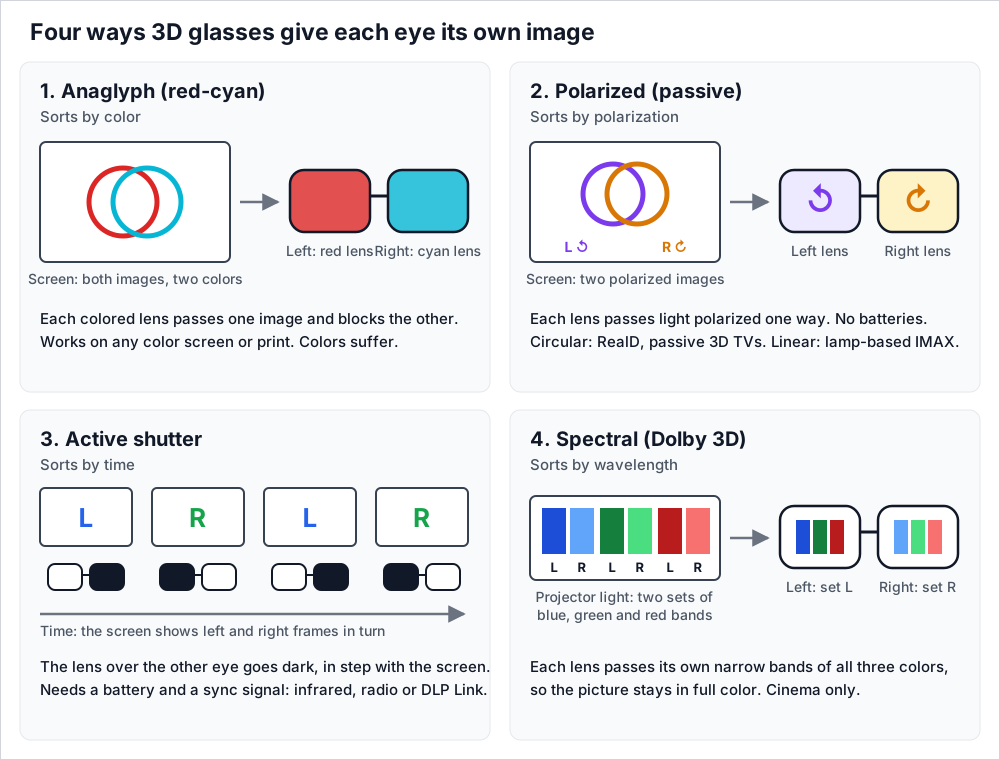
Because each type sorts differently, the glasses have to match the screen.
Which 3D glasses work with which screen
Each screen takes one kind of glasses, and at home the TV or projector you own decides which.
At home
| Screen | Glasses it needs | Do RealD cinema glasses work? |
|---|---|---|
| Passive 3D TV (LG Cinema 3D, Vizio Theater 3D, passive Toshiba sets) | Circular polarized [14][16][23] | Usually, but no TV maker promises it (see below) |
| Active 3D TV, such as Samsung's | Active shutter made for that TV's sync system [8][9] | No |
| 3D projector with DLP Link | Active shutter, DLP Link [11] | No |
| Epson RF 3D projector | Active shutter, RF [13] | No |
| Ordinary TV, monitor, phone or print | Anaglyph, with anaglyph content [3] | No |
| Glasses-free 3D display | None [1] | Not needed |
In the cinema
RealD 3D cinemas use circular polarized glasses, lamp-based IMAX 3D uses linear polarized ones, and Dolby 3D uses spectral glasses [5][6][7]. For the cinema formats themselves, see RealD vs IMAX 3D vs Dolby 3D.
Cinema by cinema: the glasses RealD, IMAX, IMAX with Laser and Dolby 3D need, and whether RealD glasses work there
| Cinema system | Glasses it needs | Do RealD cinema glasses work? |
|---|---|---|
| RealD 3D cinema | Circular polarized [5] | Yes |
| IMAX 3D, lamp-based digital | Linear polarized [6] | No: wrong polarization [6][16] |
| IMAX with Laser, two projectors | Spectral, the same kind as Dolby 3D [6][21] | No |
| IMAX with Laser, one projector | Circular polarized, from a built-in RealD filter [21] | Same type; not confirmed |
| Dolby 3D cinema | Spectral [7] | No |
3D glasses for Samsung, LG and Sony TVs
Samsung's active sets each need the active shutter model made for that TV's series, and LG's Cinema 3D sets take passive glasses. For Sony, see Sony 3D glasses below.
No major brand has made a 3D TV since 2017 (see 3D TVs in 2026), so TV glasses are for sets people already own. First find out whether yours is active or passive. Look at the glasses that came with the TV: active shutter pairs have a battery and a power button, as Samsung's do [9], and passive pairs have neither.
| Glasses | Type | Fits |
|---|---|---|
| Samsung SSG-5100GB | Active shutter, 2.4 GHz radio | Samsung D, E and F series 3D TVs, 2011 to 2013 [9] |
| Samsung SSG-5150GB | Active shutter, 2.4 GHz radio (Bluetooth) | Samsung D, E, ES, F, FH, H, HU, J, JU and JS series 3D TVs, 2011 to 2015 [22] |
| LG F310, F320 (clip-on) and F360 | Passive, circular polarized | LG Cinema 3D TVs [14][17] |
- Samsung pairs are tied to the series listed. The SSG-5100GB manual says the pair "can be used only with" those series or with 3D TVs that carry a Full HD 3D Glasses logo [9]. The SSG-5150GB manual says it is "only compatible with" the series it lists [22].
- Samsung's 2010 sets are on neither list [9][22]. Go by the glasses model named in that TV's manual.
- LG. A circular polarized pair sold for passive TVs is the other choice: one specialist retailer lists a pair for Vizio, LG and Toshiba passive 3D TVs [17].
Where to buy them. The TV makers' own stores are little help: LG's US 3D glasses page lists no products [15]. On October 7, 2026, Google's US shopping results for Samsung and Sony sets showed third-party pairs sold as compatible with a named original, and originals resold on eBay [27]. Match the model number to the table above, or to your TV's manual, before you buy.
Sony 3D glasses
Buy the glasses model named in your TV's manual, or on that TV's model page on Sony's support site. Sony was among the makers of active shutter glasses [8][10], and an active pair works only with the sync system it was made for [8][9], so a pair made for another TV may not work with yours.
3D glasses for a projector: DLP Link and RF
A 3D projector needs active shutter glasses: BenQ says projectors "only work with active 3D display standards" [12]. Which active glasses depends on the projector, and its manual names the system:
Epson's RF 3D projectors
- Glasses RF active shutter
- To buy Epson's own pair, the ELPGS03, is marked discontinued [13]
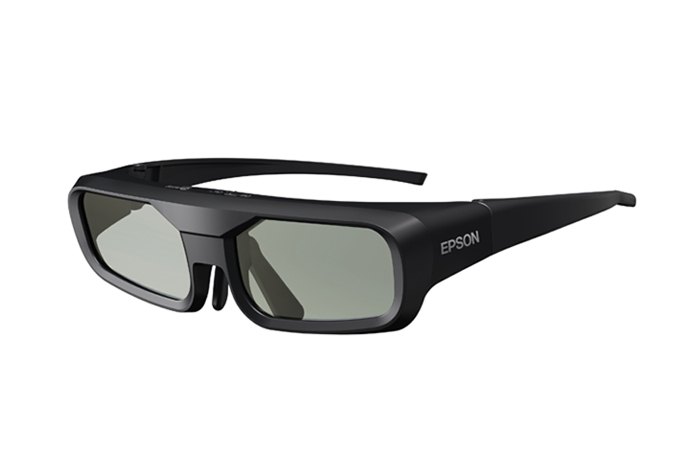
What XGIMI, AWOL Vision and Epson say about which projectors their glasses fit
3D projectors are still sold: ProjectorCentral's list, updated October 4, 2026, includes current models from BenQ, Epson, Optoma, JVC, XGIMI, Valerion and JMGO [18]. See 3D projectors.
The four types of 3D glasses
Each type in more detail, starting with the two used on home 3D TVs and projectors.
Active shutter 3D glasses
Each lens is a liquid-crystal panel that turns dark when a voltage is applied [8]. The display shows the left and right images one after the other, and the glasses black out the opposite eye in step with it [1][8].
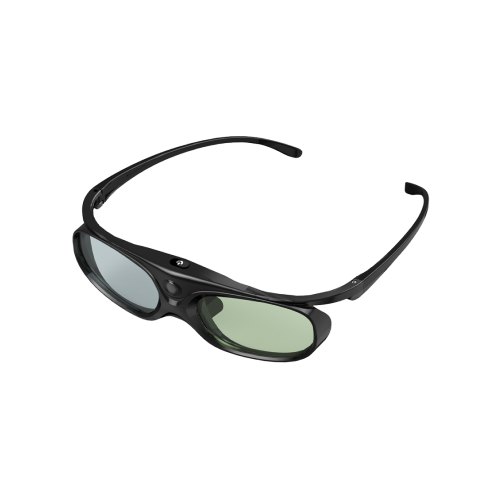
Each eye can get the full-resolution picture [8]. The costs are a battery in every pair, a higher price than passive glasses [8] and a dimmer view: Samsung lists its lenses' light transmittance at about 36% [9].
The glasses also have to receive the display's timing signal, in one of three ways: infrared, radio or DLP Link.
The three sync systems for active glasses: infrared, radio (RF, Bluetooth) and DLP Link
- Infrared (IR). Used on early active 3D TVs. Protocols differ between makers, so two infrared pairs from different brands will probably not swap [8].
- Radio (RF, Bluetooth). Many 2011 sets moved to Bluetooth radio, and in August 2011 Panasonic, Samsung, Sony and XPAND announced the Full HD 3D Glasses Initiative, to develop a shared standard for radio glasses that also covers several infrared protocols [10]. Glasses and displays that carry its logo are made to work together [9].
- DLP Link. For projectors built on Texas Instruments' DLP chips. The timing is "encoded into the light being output from the projection lens": one light pulse per frame, sent while both shutters are closed [11].
Polarized 3D glasses (passive)
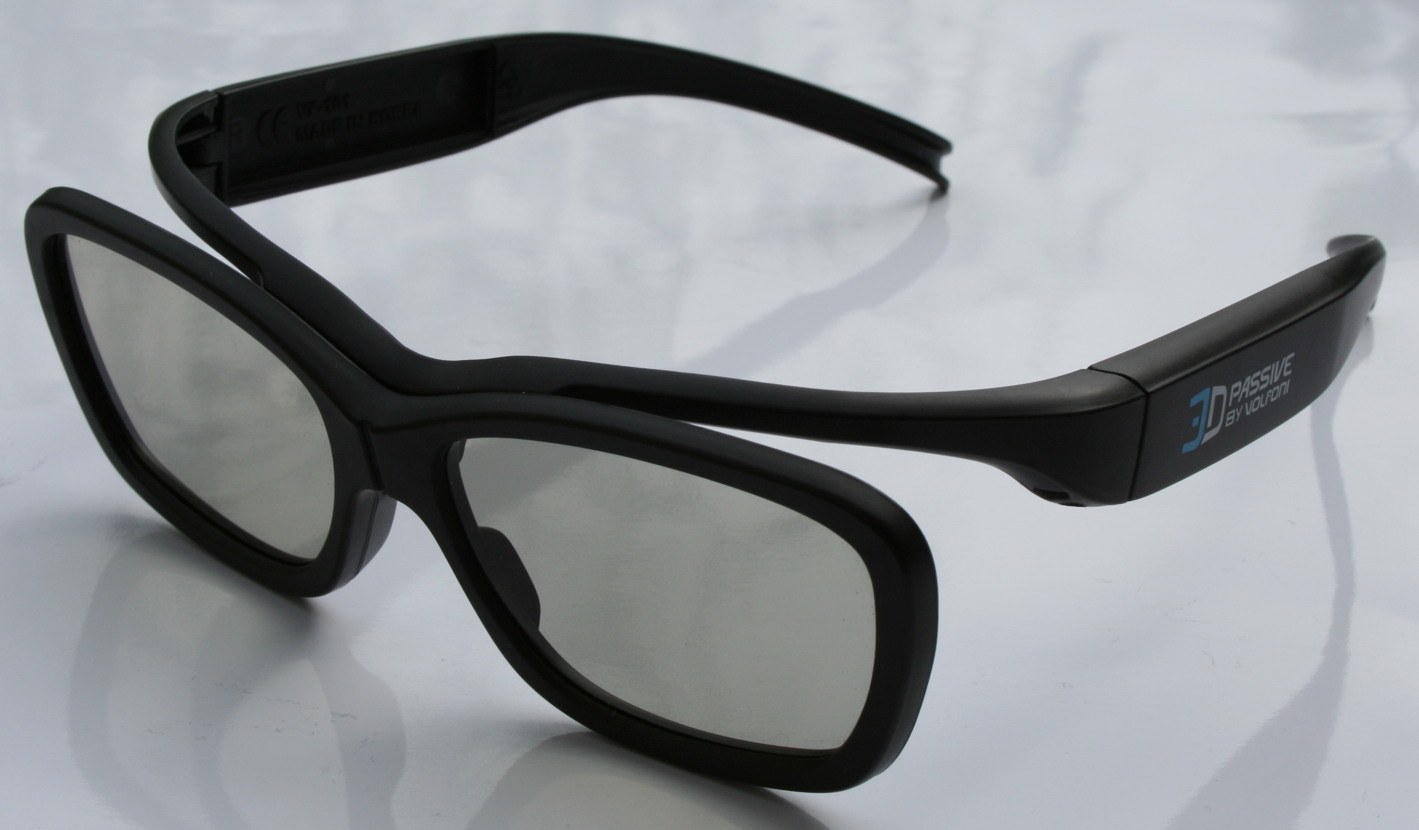
Polarized light is light whose waves are lined up in one orientation. The display sends out the left and right images polarized in opposite ways, and each lens passes one and blocks the other [1]. The glasses have no electronics, which is why they are called passive.
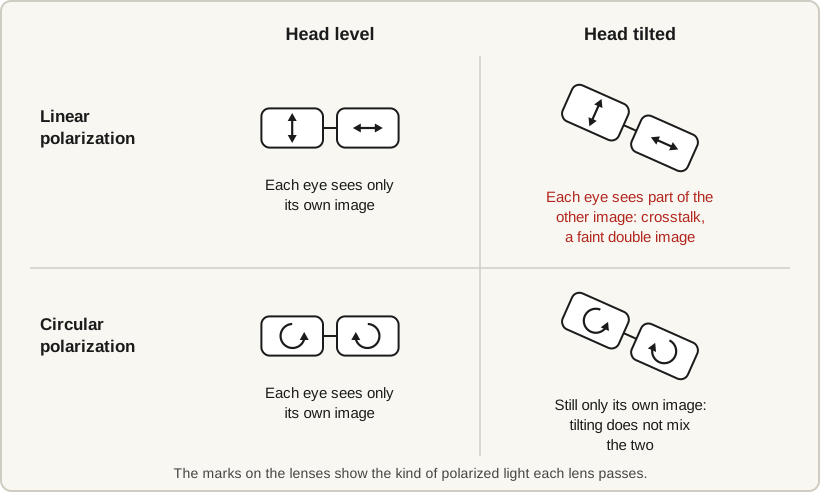
- Linear polarization. The two images are polarized at right angles: vertical and horizontal [2], or 45 and 135 degrees [4]. Tilt your head and each eye starts to see part of the other eye's image [2][4].
- Circular polarization. The light is twisted clockwise for one eye and counterclockwise for the other, so a tilted head does not mix the two images [4][5].
The leak through tilted linear glasses is called crosstalk and looks like a faint double image.
Polarized 3D in a RealD cinema and on a passive TV: the projector, the silver screen and half the lines for each eye
RealD 3D uses circular polarization: one projector alternates left-eye and right-eye frames 144 times a second, and a liquid-crystal filter in front of the lens gives each frame its twist [5].
In a cinema, both kinds need a metallic "silver screen", because an ordinary screen scrambles polarized light [2][4]. A passive 3D TV instead has a film over the panel that polarizes alternate lines of pixels in opposite directions [1][4]. Each eye sees half the lines [4]: 540 of the 1,080 on a 1080p set.
Anaglyph (red-cyan) glasses
The two images are shown on top of each other in different colors. A red filter over the left eye and a cyan (blue-green) filter over the right each pass one of them [2][3]. Because color does the sorting, anaglyph needs no special display: it works on screens and in print [3].
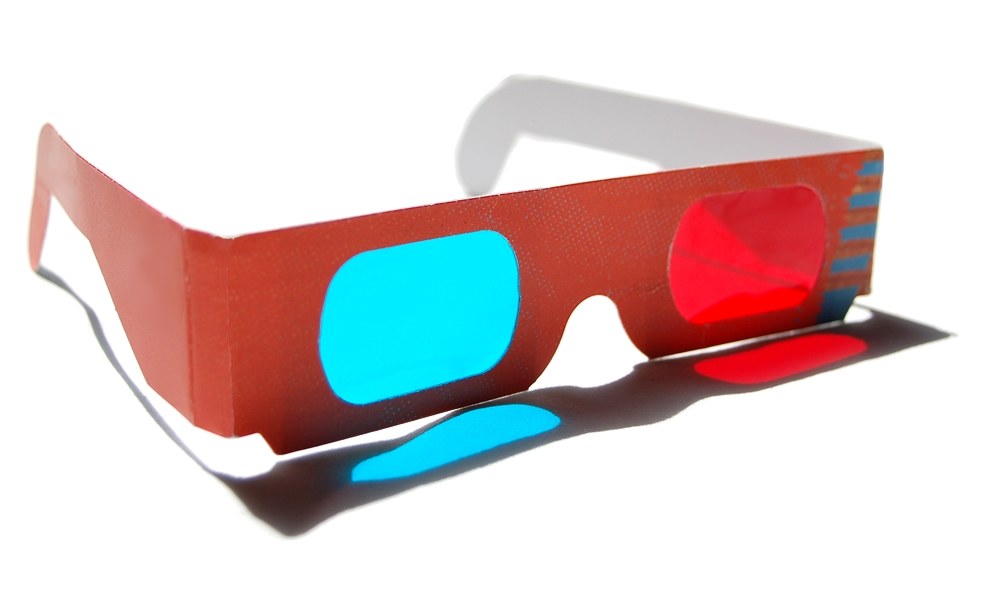
Color pays for it. Reds come out poorly [3], and a Dolby patent that surveys the methods says anaglyph "works best for black and white original images" [2]. More in anaglyph 3D.
Spectral glasses (Dolby 3D)
The projector shows each eye's image in slightly different bands of red, green and blue, and each lens passes one set and blocks the other [2][7].
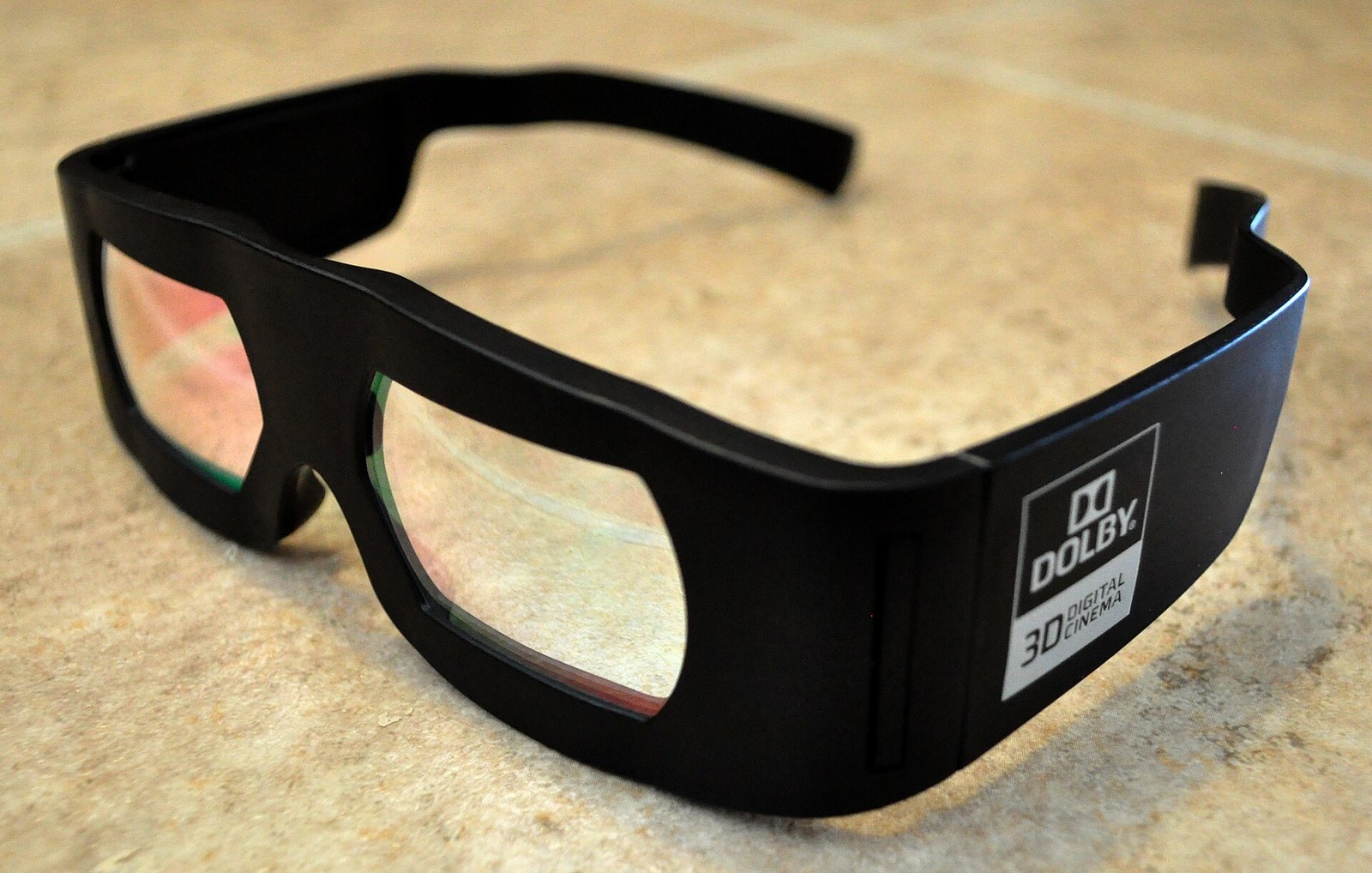
Spectral glasses compared with anaglyph and polarized: color, the screen and the lenses
Do cinema 3D glasses work at home?
Only RealD glasses, and only with a passive 3D TV: both use circular polarization [5][23]. It usually works, though we found no TV maker that promises it. On an active 3D TV they do not work, because that set separates the two images by time and needs shutter glasses [8].
IMAX and Dolby glasses do not help at home. Lamp-based IMAX glasses are linear polarized, the wrong kind for a passive TV, and spectral glasses are filters matched to a cinema projector [6][7].
The evidence that RealD glasses work on a passive 3D TV: a 2011 hands-on test, LG's statement and a retailer's listing
The evidence that this works in practice:
- A Big Picture Big Sound reviewer watched a Vizio passive 3D TV through RealD glasses borrowed from a theater in 2011. His notes on them: a very slight amber tint, and a picture a bit less crisp than through a premium aftermarket pair [23].
- LG said in 2011 that all of its 3D TV glasses could be worn in theaters that use RealD [14].
- One specialist retailer sells a single circular polarized pair for RealD theaters and for passive LG, Vizio and Toshiba TVs [17].
How much do 3D glasses cost, and where can you buy them?
From $0.75 a pair for paper red-cyan glasses to $79.90 for two DLP Link pairs. Specialist sellers and projector makers sell them new:
| Glasses | Price | Seller |
|---|---|---|
| Paper red-cyan | $7.50 for 10 ($0.75 a pair) | Rainbow Symphony [26] |
| Plastic circular polarized, for RealD theaters and passive TVs | $7.50 for 2 | Rainbow Symphony [17] |
| Circular polarized clip-ons for prescription glasses | $7.95 | Rainbow Symphony [16] |
| DLP Link active shutter, for projectors | $29.00 | XGIMI [24] |
| DLP Link active shutter, for projectors | $79.90 for 2 pairs | AWOL Vision [25] |
| Third-party active pairs sold as compatible with Samsung SSG-5100GB or Sony TDG-BT500A | About $20 to $24 a pair | Marketplace sellers on Walmart, as listed in Google's US results [27] |
Last checked : prices.
Marketplace listings change daily, so treat the last row as a rough guide.
Wearing 3D glasses over prescription glasses
Most 3D glasses go over ordinary glasses. All About Vision says many "are large enough to fit over your standard prescription glasses", though it calls the combination cumbersome [19], and Epson and AWOL Vision describe their projector glasses as fitting over eyeglasses [13][25].
For passive TVs and RealD theaters there are also circular polarized clip-ons that attach to your own frames and flip up [16]. One caution from Samsung's manual: "You may not notice the 3D effect at all if you wear glasses and have an unusual prescription" [9].
Why 3D glasses are no longer red and blue
Because color filters cost the picture its color, as the anaglyph section above describes, and can leave double images [3]. Polarized, shutter and spectral glasses give each eye a full-color picture [2][8]. Digital cinemas adopted those systems; RealD and MasterImage 3D, both circular polarized, arrived in the 2000s [4].
Were red-and-blue glasses ever the cinema standard? The 1950s, in brief
Red-and-blue glasses were never the main cinema format anyway. In the 3D boom of the 1950s, practically all features were projected through Polaroid (polarizing) filters, and the cardboard anaglyph glasses of that decade "were mainly used for comic books" and a few short films [20].
One kind of 3D screen needs no glasses at all.
3D without glasses
A glasses-free 3D screen moves the filter from your face to the display. An optical layer on the panel, either a parallax barrier (a mask of fine slits) or a lenticular lens (an array of tiny cylindrical lenses), sends each image toward the correct eye. The technical name is an autostereoscopic display, and a single-viewer design shows 3D to one person at a time [1].
One example is the Owl3D Shift, a 14-inch glasses-free 3D display, priced at 499 US dollars, that sits beside a computer as a second monitor. Owl3D, the publisher of this guide, makes the Shift.
An eye-tracking camera follows the viewer and the display steers each eye's image to where the eyes are; it shows 3D to one viewer at a time and switches automatically when people take turns. The eye tracking works for people who wear prescription glasses, so you keep your own pair on and put nothing over it.
It shows side-by-side and top-bottom 3D video playing on the computer as it is, and its Live 3D Screen feature converts any ordinary 2D window to 3D instantly, in real time, as the picture plays; that conversion is an AI estimate of depth, not a film's own 3D version. It is a desk display, not a TV, and it needs a capable computer running the Owl3D app.
From Owl3DOwl3D ShiftA 14-inch glasses-free 3D display that sits beside your computer.See also can you watch 3D without glasses, glasses-free 3D monitors compared and what a lenticular lens is.
Frequently asked questions
Do 3D glasses work on any TV?
No. Passive and active glasses work only with a 3D TV of the matching kind, because the TV has to polarize the two images or show them in turn [1][8]. A smart TV is not a 3D TV unless its specifications say so. Red-cyan glasses with anaglyph video are the one exception [3].
How can I turn my regular TV into a 3D TV?
You cannot, with glasses alone. The 3D is made by the screen, which has to polarize the two images or show them in turn [1][8]; glasses only sort what the screen sends out. For the routes that work today, see how to watch 3D movies at home.
Do 3D glasses actually work for everyone?
Not equally. Samsung's manual says "The 3D effect may be experienced differently depending on the viewer" [9]. All About Vision says some people cannot process the illusion at all, and that the headaches, dizziness and nausea that packaging warns about are "generally short-term effects" [19].
What 3D glasses work with a computer monitor?
On an ordinary monitor, only anaglyph glasses [3]. Shutter-glass kits for PCs did exist: Nvidia's 3D Vision kit combined shutter glasses, a transmitter and driver software, and needed a 120 Hz monitor [8]. See what replaced Nvidia 3D Vision and glasses-free 3D monitors.
Sources (27)
- Tom Kimpe, Stijn Crul and Viktor Vörös (Barco), "Autostereoscopic Displays for Healthcare Applications", invited paper 29-4, SID 2025 Digest, pp. 385-388. https://sid.org/Portals/sid/Files/SID-Digest/docs/29-4.pdf (opened 2026-10-07)
- Dolby Laboratories Licensing Corp, US Patent 8,403,489 B2, "Spectral separation filters for 3D stereoscopic D-cinema presentation", priority date May 18, 2007, granted March 26, 2013. https://patents.google.com/patent/US8403489 (opened 2026-10-07)
- Wikipedia, "Anaglyph 3D". https://en.wikipedia.org/wiki/Anaglyph_3D (opened 2026-10-07)
- Wikipedia, "Polarized 3D system". https://en.wikipedia.org/wiki/Polarized_3D_system (opened 2026-10-07)
- Wikipedia, "RealD 3D". https://en.wikipedia.org/wiki/RealD_3D (opened 2026-10-07)
- Wikipedia, "IMAX". https://en.wikipedia.org/wiki/IMAX (opened 2026-10-07)
- Wikipedia, "Dolby 3D". https://en.wikipedia.org/wiki/Dolby_3D (opened 2026-10-07)
- Wikipedia, "Active shutter 3D system". https://en.wikipedia.org/wiki/Active_shutter_3D_system (opened 2026-10-07)
- Samsung, "3D Active Glasses SSG-5100GB User's Guide" (file dated January 2, 2013), PDF hosted by the retailer Conrad. https://asset.conrad.com/media10/add/160267/c1/-/en/000408183ML01/manual-408183-samsung-ssg-5100gb-black.pdf (opened 2026-10-07)
- Engadget, "Panasonic, Sony, Samsung and XpanD finally team up for an active 3D glasses standard", by Richard Lawler, August 8, 2011, with the companies' press release. https://www.engadget.com/2011-08-08-panasonic-sony-samsung-and-xpand-finally-team-up-for-an-active.html (opened 2026-10-07)
- Texas Instruments, "DLPC3479" data sheet DLPS112D, June 2018, revised March 2026, section on 3D glasses operation. https://www.ti.com/document-viewer/lit/html/DLPS112D/GUID-760C2338-2FBF-4B22-B271-333063B1A2A7.html (opened 2026-10-07)
- BenQ, "Is Passive 3D supported by the projector?", projector FAQ, May 20, 2022. https://www.benq.com/en-in/support/downloads-faq/faq/product/application/projector-faq-kn-00087.html (opened 2026-10-07)
- Epson, "Epson 3D Glasses (RF) ELPGS03" product page (V12H548006). https://epson.com/For-Home/Projectors/Accessories/RF-3D-Glasses-%28ELPGS03%29/p/V12H548006 (opened 2026-10-07)
- LG Electronics, "LG Unveils Stylish New 3D Glasses for 2012", press release, December 26, 2011. https://www.lg.com/global/newsroom/news/media-entertainment-solution/lg-unveils-stylish-new-3d-glasses-for-2012/ (opened 2026-10-07)
- LG USA, "LG 3D TV Glasses for Passive 3D Televisions". https://www.lg.com/us/3d-glasses/view-all (opened 2026-10-07)
- Rainbow Symphony, "Circular Polarized 3D TV Glasses - Clip-on Style" product page. https://www.rainbowsymphony.com/products/circular-polarized-clipon-3dglasses3 (opened 2026-10-07)
- Rainbow Symphony, "Circular Polarized 3D Glasses - RealD 3D & Disney Digital 3D Theatres" product page. https://www.rainbowsymphony.com/products/plastic-circular-polarized-3d-glasses (opened 2026-10-07)
- ProjectorCentral, "Top 3D Projectors 2026", updated October 4, 2026. https://www.projectorcentral.com/top-3D-Projectors.htm (opened 2026-10-07)
- All About Vision, "3D Glasses", by Rob Woods, March 2, 2021. https://www.allaboutvision.com/eyewear/specialty/3d-glasses/ (opened 2026-10-07)
- Wikipedia, "3D film". https://en.wikipedia.org/wiki/3D_film (opened 2026-10-07)
- Chris Chinnock, "A Visit with IMax's David Keighley", Display Daily, May 19, 2018. https://displaydaily.com/a-visit-with-imax-s-david-keighley/ (opened 2026-10-07)
- Samsung, "3D Active Glasses SSG-5150GB" user manual (file dated March 10, 2016), Samsung download center. https://downloadcenter.samsung.com/content/UM/201611/20161123110738756/SSG-5150GB_XC_InBox_BN68-05527C-00_L04_160329.0.pdf (opened 2026-10-07)
- Chris Boylan, "Oakley 3X Gascan HDO 3D Glasses Quick Take Review", Big Picture Big Sound, July 12, 2011. https://www.bigpicturebigsound.com/Oakley-3X-Gascan-HDO-3D-Glasses-Quick-Take.shtml (opened 2026-10-07)
- XGIMI US store, "Active Shutter 3D Glasses" product page. https://us.xgimi.com/products/3d-glasses (opened 2026-10-07)
- AWOL Vision, "AWOL 3D Glasses" product page. https://awolvision.com/products/3d-glasses (opened 2026-10-07)
- Rainbow Symphony, "Paper 3D Glasses Red/Cyan Lenses" product page. https://www.rainbowsymphony.com/products/red-cyan-paper-3d-glasses (opened 2026-10-07)
- Google search results for "3d glasses for tv", United States, desktop: product listings as captured on October 7, 2026. https://www.google.com/search?q=3d+glasses+for+tv&hl=en&gl=US (captured 2026-10-07)