What Is a RealD 3D Movie? RealD 3D vs IMAX 3D vs Dolby 3D
How we researched this: written by Owl3D from published sources, all 35 listed at the end.
Short answer
A RealD 3D movie is an ordinary 3D movie: real stereoscopic 3D, watched with glasses. RealD is the brand of the projection system, and it is the most widely used 3D system in theaters.
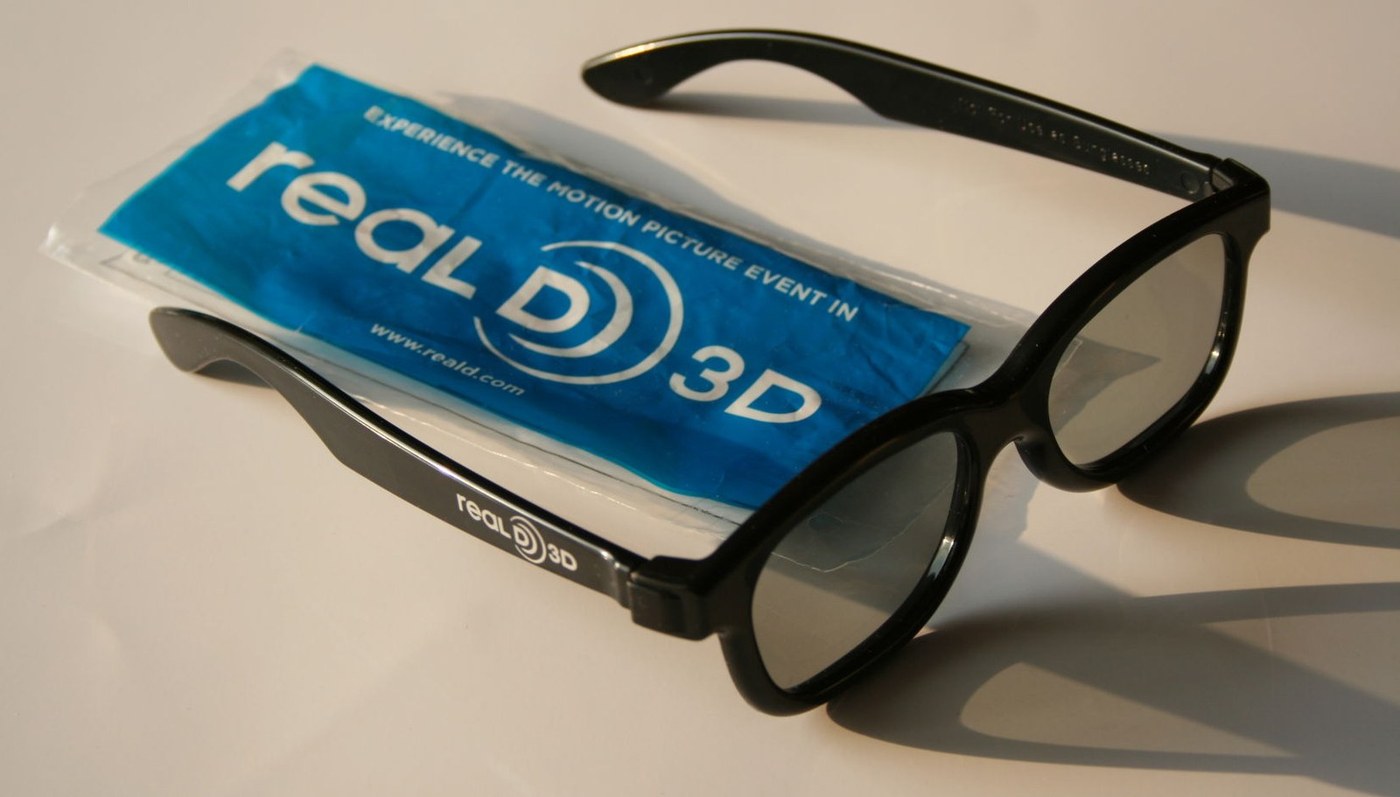
What you are handed at a RealD 3D showing: light plastic polarized glasses, in the bag they come in. Photo: Gmhofmann, public domain, via Wikimedia Commons.
Key takeaways
- For one film in New York in December 2025, a ticket cost $22.49 in 2D, $26.99 in RealD 3D, $30.49 in IMAX 3D and $31.99 in Dolby 3D [9]. See what the extra money buys.
- IMAX is a big-screen format that plays films in 2D or in 3D, so "IMAX" alone does not mean 3D. See IMAX vs 3D.
- Dolby 3D is the 3D in Dolby Cinema auditoriums, on a smaller screen than IMAX, with the highest published 3D brightness figure we found. See what Dolby 3D is.
- "Digital 3D" on a ticket is not a brand, and at a large US chain it most likely means RealD. See what "Digital 3D" means.
- Of the theater glasses, only RealD's are of use at home, and only with a passive 3D TV. See theater glasses at home.
Quick picks
- The lowest priceStandard 2D
- 3D at the lowest price, or the most showtimesRealD 3D
- The brightest 3DDolby Cinema 3D
- The biggest 3D pictureIMAX 3D, with Laser if you can
- The brightest picture, and no glassesIMAX 2D or Dolby Cinema 2D
What is a RealD 3D movie? Is it real 3D?
Yes, it is real 3D. A 3D movie is two movies shown together, one made for the left eye and one for the right, and the theater has to get each image to the correct eye [4]. RealD 3D, IMAX 3D and Dolby 3D are brand names for ways of doing that sorting.
The 3D belongs to the film, not to the theater: Avatar: Fire and Ash opened in December 2025 in "IMAX 3D, Dolby Cinema 3D and 2D, RealD 3D" and other formats on the same day [13].
RealD is the most common of these systems [1][8]: the company counts "more than 22,000 installed screens in 72 countries" [14]. At AMC, Cinemark and Regal, a "RealD 3D" showing is most likely the regular 3D showing, not a special version.
The evidence, chain by chain: AMC, Cinemark and Regal
| Chain | Evidence | Source |
|---|---|---|
| AMC | Names RealD among its formats; 3D-enabled screens in 524 of its 533 US theaters | Annual report for 2025 [12] |
| Cinemark | Offers "both 2-D and 3-D formats in all of our theaters" [16]; more than half of its US screens RealD 3D capable in December 2011 [17] | Annual report for 2025 [16]; its own statement, 2011 [17] |
| Regal | RealD 3D went into ScreenX auditoriums in a rollout announced with Regal | Announcement, December 2025 [18] |
RealD 3D vs IMAX 3D vs Dolby 3D at a glance
All three show the same film in 3D. What changes is the screen, the glasses, the brightness and the price.
| Showing | What it is | Screen | Glasses | Ticket, New York, December 2025 [9] |
|---|---|---|---|---|
| Standard 2D | The regular showing | Regular size | None | $22.49 |
| RealD 3D | The most common 3D system, in regular auditoriums [1] | Regular size, silver [4] | Cheap polarized, treated as disposable [4][5] | $26.99 |
| IMAX 3D | A 3D showing on an IMAX screen [2] | The largest [8][9] | Matched to the projector [2][6] | $30.49 |
| Dolby 3D | The 3D system in Dolby Cinema auditoriums [3] | Smaller than IMAX [9], matte white [3] | Color-filter, collected and reused [3][5][7] | $31.99 |
Last checked : the December 2025 prices and the 2025 screen counts, against their sources.
The prices are for one film, Avatar: Fire and Ash, in one expensive city [9]; read them for the gaps between formats.
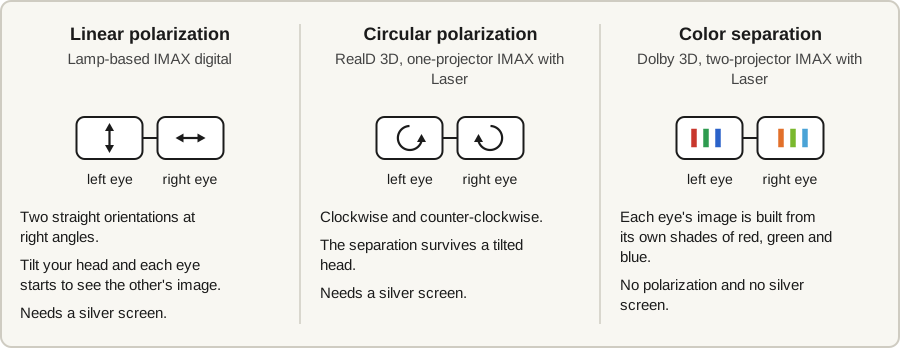
The three systems also differ in how they give each eye its own image, so each has its own kind of glasses.
Published 3D brightness and AMC screen counts for each system
| System | Published 3D brightness | AMC screens in the US, end of 2025 [12] |
|---|---|---|
| RealD 3D | No single figure [10] | 2,795 3D-enabled |
| IMAX 3D | 11 foot-lamberts to the eye, one-projector IMAX with Laser only [6] | 186 IMAX |
| Dolby 3D | Up to 14 foot-lamberts on screen [3][11] | 174 Dolby Cinema |
RealD's brightness depends on the theater's projector and upkeep [10]. A foot-lambert (fL) is a unit of screen brightness, and the cinema standard for a 2D picture is 14 [1].
AMC had 7,072 screens in the US at that date, and its 3D-enabled count is not split by system [12].
2D, RealD 3D, IMAX 3D or Dolby 3D: which showing to book
RealD 3D is the easiest 3D to find and, in the price example above, the cheapest. Pay more for Dolby Cinema 3D if you want the brightest 3D, or for IMAX 3D if you want the biggest screen.
| If you want | Book | Why |
|---|---|---|
| The lowest price | Standard 2D | $4.50 less than RealD 3D in the New York example [9] |
| 3D at the lowest price, or the most showtimes | RealD 3D | The most widely available 3D [8][12]; quality depends on the theater [10] |
| The brightest 3D | Dolby Cinema 3D | Up to 14 foot-lamberts (fL) of brightness on screen, the level theaters aim for in 2D [1][3] |
| The biggest 3D picture | IMAX 3D, with Laser if you can | Screen size is IMAX's selling point [8]; the laser system has a published 3D brightness figure [6] |
| The brightest picture, and no glasses | IMAX 2D or Dolby Cinema 2D | 22 fL for IMAX [6], up to 31 fL for Dolby Cinema [11] |
These picks come from published specifications and from other people's reports, not from our own side-by-side viewing.
What the extra money buys
Mostly the premium auditorium, not the 3D. In the New York example, 3D alone added $4.50 in a regular auditorium and $1.50 inside Dolby Cinema, where the 2D ticket was $30.49 [9].
Prices vary by city and theater. AMC's A-List subscription covers RealD, IMAX and Dolby Cinema showings [12].
Dolby Cinema 3D vs IMAX 3D
Dolby Cinema 3D has the higher brightness figure, and IMAX 3D has the larger screen [8][9][11]. James Cameron, the director of the Avatar films, has said he is divided between the two and likes Dolby's brighter light levels for 3D despite the smaller screen, according to MovieWeb's account of a podcast interview [9].
What MovieWeb's reviewer found, and IMAX with Laser 3D against Dolby Cinema 3D
The MovieWeb writer, who saw Avatar: Fire and Ash at a Dolby 3D screening, rated Dolby 3D best for color contrast and IMAX 3D best for screen size [9].
The same holds for IMAX with Laser 3D against Dolby Cinema 3D. Both use laser projectors, and their published figures, 11 fL to the eye and up to 14 fL on screen, are not measured the same way.
Dolby Cinema 3D vs RealD 3D
Dolby Cinema 3D is a fixed setup with a published brightness figure [3]. RealD 3D varies with each theater's projector and upkeep [10], costs less and is in far more theaters [9][12].
What MovieWeb's comparison said about standard RealD 3D
The MovieWeb comparison listed "Mediocre lighting/sound quality" among the drawbacks of standard RealD 3D, and still called it "a solid, widely available option" for that film, which was shot for 3D [9].
IMAX 3D vs RealD 3D
IMAX 3D is the same 3D on a much larger screen, for $3.50 more in the New York example [9]. In a one-projector IMAX with Laser auditorium even the 3D method is RealD's [6], so you are paying for the screen and the projector.
IMAX vs 3D: what is the difference?
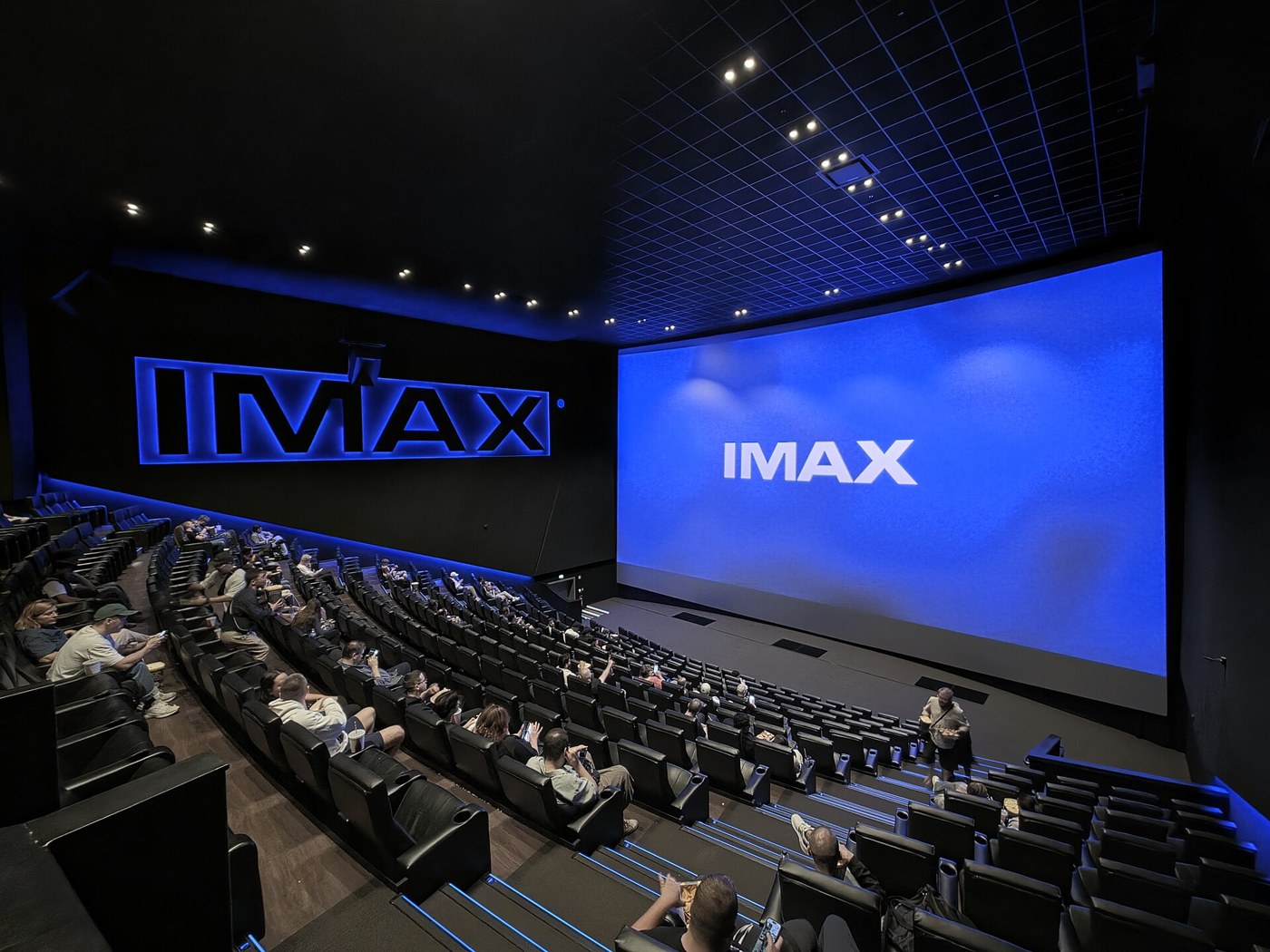
IMAX and 3D are two different things. IMAX is a theater format with its own projectors and very large screens [2][8]. 3D is the depth effect you see through glasses.
An IMAX auditorium shows films in 2D or in 3D [2], so one film can play four ways: regular 2D, regular 3D (usually RealD), IMAX 2D and IMAX 3D.
IMAX 2D or IMAX 3D?
IMAX 2D is the brighter picture. The cinema standard for a 2D picture is 14 foot-lamberts (fL) [1]. IMAX sets its 2D brightness at 22 fL, 60 percent above that standard [6]. In 3D, its one-projector laser system delivers 11 fL to the eye [6], half as much.
Choose IMAX 3D when the film was made with 3D in mind and you want the depth. Choose IMAX 2D for the brightest picture and no glasses.
Is IMAX 3D the same as normal 3D?
It is the same film's 3D on a bigger screen. How the two images are separated depends on the projector in that auditorium, so "IMAX 3D" tells you the screen and the brand, not the 3D method.
The three IMAX projector types: how each separates the two images, and which glasses it needs
| IMAX projector | Dates from, and screen size | How the two images are separated | Glasses |
|---|---|---|---|
| Lamp-based digital: two 2K projectors [2] | Introduced in 2008 [2] | Linear polarization [2][19], silver screen [19] | Linearly polarized [2][19], larger than ordinary ones [19] |
| IMAX with Laser, two projectors | Launched in December 2014 [2]; screens wider than 80 feet [6] | Color separation [6] | Color-filter [2] |
| IMAX with Laser, one projector | Announced in 2018 [6]; screens up to 80 feet wide [6] | Circular polarization, from a built-in RealD ZScreen [6] | Circularly polarized [6] |
The two-projector laser glasses are "similar to those used by Dolby 3D" [2]. The one-projector laser system uses the method RealD 3D uses [6].
In a two-projector IMAX auditorium, a 2D showing stacks both projectors' images for brightness, and a 3D showing gives one projector to each eye [2].
Pathé's Dutch theaters tell customers that IMAX with Laser 3D needs its own glasses, that regular 3D glasses do not work, and that the right pair is marked on the side [20].
Polarization and color separation are explained in how each system works.
What is Dolby 3D? Is Dolby Cinema 3D?
Dolby Cinema is Dolby's premium auditorium, branded Dolby Cinema at AMC in the US [3]. It is not 3D by default. Dolby's own page speaks of "both 2D and 3D movies" there [21], and Avatar: Fire and Ash played in Dolby Cinema in both versions [13].
A Dolby Cinema ticket is 3D only when the listing says 3D.
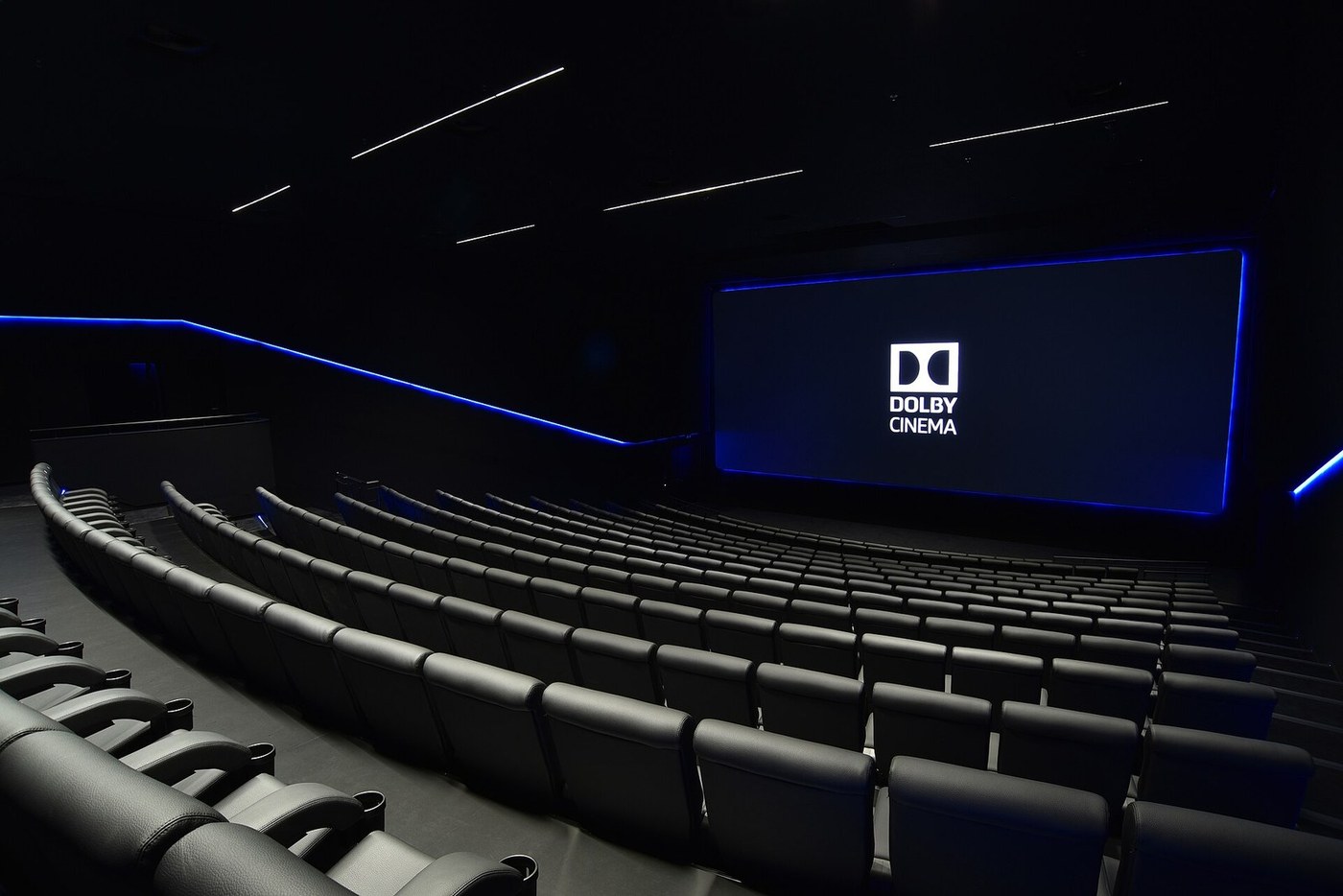
Dolby 3D is the 3D system in those auditoriums. Its glasses cost more than polarized ones, so the theater collects and reuses them [5][22].
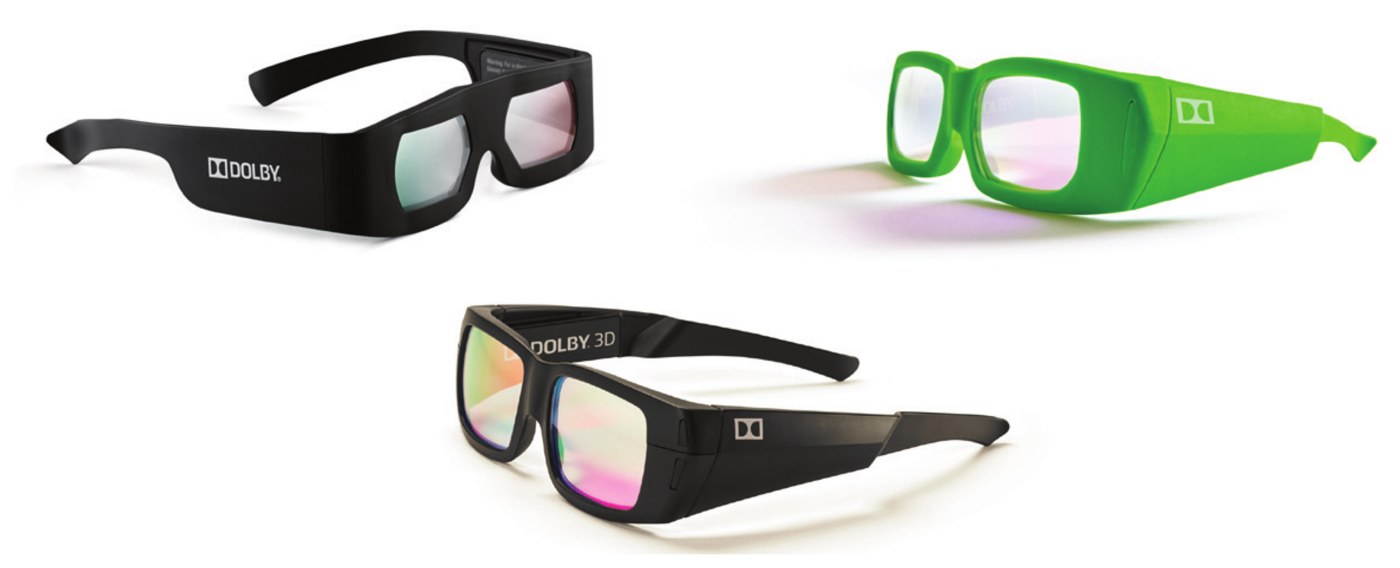
Brightness is its selling point: up to 14 fL on screen in 3D [3][11][23] and up to 31 fL in 2D [3][11]. The 3D systems it was compared with at the time delivered 3 to 4 fL [3].
How Dolby 3D separates the two images, and the older version withdrawn in 2018
Two Christie 4K laser projectors run together, each producing its own slightly different red, green and blue, and color-filter glasses pass one set to each eye [3]. The screen is matte white, not silver [3].
"Dolby 3D" once also meant an older, lamp-based version. Dolby withdrew those systems from sale on June 30, 2018, and the Dolby 3D it has listed since then is for laser projection [7].
Which movies are in RealD 3D now, and how to find a showing
On October 7, 2026, RealD's site was promoting these films in RealD 3D, among others [26]:
| Film | In theaters |
|---|---|
| Forgotten Island | In US theaters since September 25, 2026 [27] |
| Avengers Endgame: Encore | Re-release, opened in September 2026 [28] |
| Pan's Labyrinth | Back with a 3D version on October 9, 2026 [29] |
| Hexed | Opens November 25, 2026 [30] |
| Avengers: Doomsday | Opens December 18, 2026 [28] |
Last checked : the films on RealD's site and their dates.
A RealD 3D fan event for Avengers: Doomsday is on sale [26]. Whether a film also plays in IMAX 3D or Dolby Cinema 3D differs from film to film. For older films where the 3D is the point, see the best 3D movies.
To find a showing:
- RealD 3D. RealD's home page links each film to its 3D showtimes on Fandango [26], and Fandango keeps a page of 3D movies in theaters [31]. On a theater's own site, choose the showtime labeled 3D or RealD 3D.
- Dolby Cinema 3D. Dolby's finder lists Dolby Cinema locations [32]. Then check that the showtime says 3D.
- IMAX 3D. The listing must say "IMAX 3D", not only "IMAX". To learn which projector an IMAX auditorium has, ask the theater.
What "Digital 3D" means on a ticket
"Digital 3D" is not a brand. It is a general term for 3D that is made and shown digitally, and the formats under it include RealD 3D, Dolby 3D, IMAX 3D, MasterImage 3D and XpanD 3D [34].
In the US, a plain "3D" or "Digital 3D" listing at a large chain most likely means RealD, for the reasons given under what a RealD 3D movie is [1][12]. The label does not promise any one system, so ask the theater if it matters to you.
ScreenX on a ticket means side-wall images for a 270-degree picture [35]. Since December 2025, RealD 3D has been going into ScreenX auditoriums, starting with Regal for Avatar: Fire and Ash [18].
What you give up in 3D: brightness and comfort
Every 3D system loses light. Christie, a maker of cinema projectors, wrote in 2014 that the 3D equipment of that time (filters and glasses) absorbed 70 to 90 percent of it [24]. The recommended level for 3D is 7 fL, with 5 to 9 acceptable, against the 14 fL standard for 2D [1].
Why the published brightness figures cannot be ranked exactly
The published figures cannot be ranked exactly. Dolby's 14 fL is an on-screen figure [11]. IMAX's 11 fL is given "to the eye" [6], which we read as after the glasses.
RealD's brightness is that of the theater's own projector [4]: in a 2013 demonstration, one laser projector with a RealD system reached 14 fL on a 65-foot screen [24].
Does 3D cause headaches or eye strain?
Some people feel unwell in 3D. In a 2013 study, 497 healthy adults filled in a symptom questionnaire before and after films. After a 3D movie, 54.8 percent reported some sickness; after a 2D movie, 14.1 percent did [25].
What the study's author concluded, and why 3D can strain the eyes
The author concluded that seeing 3D movies can increase ratings of nausea, eye-related symptoms and disorientation, and called for studies to confirm it [25].
Two things about 3D are unnatural for the eyes. One is crosstalk, or ghosting, covered in how each system works. The other is that your eyes focus on the screen while they aim at an object that appears in front of it or behind it [1].
Christie compares watching a dim 3D picture to reading in low light, with the headache and eyestrain that go with it [24].
Do theater 3D glasses work at home?
Only RealD's, and only with one kind of home screen:
| Theater glasses | Type | Home screen they suit |
|---|---|---|
| RealD | Circularly polarized [4] | A passive 3D TV, usually |
| Lamp-based IMAX | Linearly polarized [2] | None |
| Dolby 3D, and two-projector IMAX with Laser | Color filters matched to cinema laser projectors [2][7] | None |
RealD glasses. Passive 3D TVs, such as those LG and Vizio made, also used circular polarization, with glasses "similar to those for movies" [19][33]. So RealD glasses usually work on a passive 3D TV, though no TV maker promises it; the evidence is in types of 3D glasses. Those TVs are no longer made; see 3D TVs in 2026.
Why IMAX and Dolby glasses do not help, and what active-shutter sets need
IMAX and Dolby glasses do not help at home. Linear polarization is the wrong type for a circularly polarized TV.
Active-shutter 3D TVs and projectors need powered glasses synchronized to the display [1], so none of the passive theater glasses work with them. See 3D projectors.
A VR headset or a glasses-free 3D display needs no 3D glasses at all. See watching 3D without glasses.
How each system works, and where ghosting comes from
Theaters sort the two images by polarization or by color. When the sorting is imperfect, part of one eye's image reaches the other eye. That is crosstalk, and you see it as ghosting, a faint double image [1].
| Method | Used by | Screen | If you tilt your head |
|---|---|---|---|
| Linear polarization | Lamp-based IMAX digital | Silver [33] | Each eye starts to see the other's image [1][33] |
| Circular polarization | RealD 3D, one-projector IMAX with Laser | Silver [33] | The separation survives [1] |
| Color separation | Dolby 3D, two-projector IMAX with Laser | No silver screen [3][24] | No polarization to disturb [3][24] |
In every system the two images are offset horizontally, so a strongly tilted head makes the depth look wrong even when the separation holds [4][33].
Polarization: linear and circular, and why it needs a silver screen
The two images are projected through opposite polarizing filters, and each lens of the glasses passes only its own image [33]. It needs a silver screen, because an ordinary white screen scrambles polarized light [33]. Silver screens are brighter straight in front of you and dimmer toward the edges [24].
Linear polarization uses two straight orientations at right angles [33]. Tilt your head and the lenses stop lining up with the projector's filters [1][33].
Circular polarization uses clockwise and counter-clockwise [4][33]. Its separation depends instead on the silver screen and on upkeep [10][33].
Color separation: six colors, and glasses matched to the projector
Each eye's image is built from its own, slightly different shades of red, green and blue, and each lens passes only its own set [1][22]. A laser system makes the six colors at the source, three for each eye, so no light is thrown away at the projector [24], and each eye has its own projector [2][3][6].
Separation depends on the glasses matching the projector's exact colors: Dolby sells different glasses for Christie laser projectors and for Barco ones [7].
Ghosting, as viewers reported it
Reports of ghosting from people who watched are few and mostly old. A 2012 /Film comparison of that era's lamp-based systems reported "very little ghosting" in Dolby 3D, and its author found traditional IMAX "more prone to ghosting" than RealD [5].
A Display Daily writer who saw a demonstration of one-projector IMAX with Laser 3D in 2018 noticed "a little ghosting in some shots" [6].
How RealD 3D works
RealD uses circular polarization and one projector.
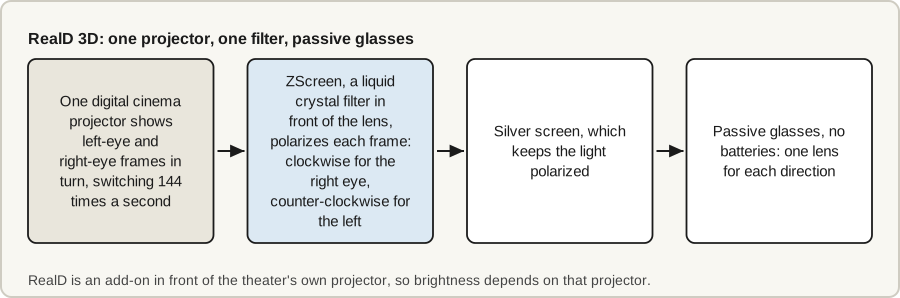
RealD is not a projector. It is an add-on in front of a digital cinema projector [4], so brightness depends on the projector behind it.
Inside RealD 3D: 144 frames a second, the ZScreen filter and what upkeep changes
The projector shows left-eye and right-eye frames in turn, switching 144 times a second, with each frame shown three times to hide flicker [4].
A liquid crystal filter called a ZScreen sits in front of the lens and polarizes each frame: clockwise for the right eye, counter-clockwise for the left [4]. The glasses are passive (no batteries), with one lens for each direction [4].
RealD tells theaters that brightness and "stereo contrast" also depend on the condition of the silver screen and the port window (the glass the projector shines through), and on how clean and well set up the system is [10].
Frequently asked questions
Do you need glasses for RealD 3D?
Yes. Both eyes' images are on the screen at once, and the glasses are what keep them apart [4]. You pick them up at the theater.
Is RealD 3D the same as 3D? Is RealD 3D at AMC actually 3D?
Yes to both. "RealD" names the system the theater uses, as "IMAX 3D" and "Dolby 3D" do, and the picture is stereoscopic 3D with a separate image for each eye. AMC has used RealD since at least 2011 [15].
Is RealD 3D worth it?
For a film made with 3D in mind, in a well-kept theater, yes. In the New York example it was the cheapest 3D ticket, $4.50 more than 2D [9], and the result depends on the theater's projector and upkeep [10].
Dolby Cinema 3D and one-projector IMAX with Laser publish 3D brightness figures and cost more [3][6][9]. If 3D has made you feel ill before, choose 2D [25].
Can you watch RealD 3D at home?
Not RealD itself. It is a theater system [14], and there is no RealD projector to buy for a living room. You can watch many of the same films in 3D at home on a 3D Blu-ray, a VR headset or a 3D display.
See how to watch 3D movies at home, 3D Blu-ray and which streaming services have 3D movies.
Sources (35)
- Wikipedia, "3D film". https://en.wikipedia.org/wiki/3D_film (opened 2026-10-07)
- Wikipedia, "IMAX". https://en.wikipedia.org/wiki/IMAX (opened 2026-10-07)
- Wikipedia, "Dolby Cinema". https://en.wikipedia.org/wiki/Dolby_Cinema (opened 2026-10-07)
- Wikipedia, "RealD 3D". https://en.wikipedia.org/wiki/RealD_3D (opened 2026-10-07)
- Peter Sciretta, "Q&A: Which Is The Best 3D Format?", /Film, February 3, 2012. https://www.slashfilm.com/qa-best-3d-format/2/ (opened 2026-10-07)
- Chris Chinnock, "A Visit with IMax's David Keighley", Display Daily, May 19, 2018. https://displaydaily.com/a-visit-with-imax-s-david-keighley/ (opened 2026-10-07)
- Dolby Laboratories, "Dolby 3D" product sheet, March 1, 2019. https://professional.dolby.com/siteassets/products/dolby-imaging-solutions-for-media/dolby-3d/dolby_3d_product_sheet.pdf (opened 2026-10-07)
- Quentin Couprie, "IMAX, Dolby, 4DX, ScreenX… which format to choose to fully experience Avatar 3 in the cinema?", 3DVF, December 17, 2025. https://3dvf.com/en/imax-dolby-4dx-screenx-which-format-to-choose-to-fully-experience-avatar-3-in-the-cinema (opened 2026-10-07)
- Charles Papadopoulos, "I Saw 'Avatar 3' In James Cameron's Favorite Format - Was It Worth It?", MovieWeb, December 17, 2025. https://movieweb.com/avatar-fire-ash-format-guide-what-is-james-cameron-favorite/ (opened 2026-10-07)
- RealD, "Better 3D". https://www.reald.com/better3d (opened 2026-10-07)
- Digital Cinema Report, "Dolby Launches Dolby Cinema", December 3, 2014. https://www.digitalcinemareport.com/dolby-launches-dolby-cinema/ (opened 2026-10-07)
- AMC Entertainment Holdings, Inc., Form 10-K for the fiscal year ended December 31, 2025, US Securities and Exchange Commission. https://www.sec.gov/Archives/edgar/data/1411579/000141157926000016/amc-20251231x10k.htm (opened 2026-10-07)
- The Walt Disney Company UK press site, "The World of Avatar Comes to Hollywood for World Premiere of Avatar: Fire and Ash at Dolby Theatre", December 2, 2025. https://press.disney.co.uk/news/the-world-of-avatar-comes-to-hollywood-for-world-premiere-of-avatar-fire-and-ash-at-dolby-theatre (opened 2026-10-07)
- RealD, "About". https://www.reald.com/about (opened 2026-10-07)
- Hollywood in Hi Def, "AMC rolls out RealD 3D in 1,000 more screens", July 28, 2011. https://hollywoodinhidef.com/2011/07/amc-rolls-out-reald-3d-in-1000-more-screens/ (opened 2026-10-07)
- Cinemark Holdings, Inc., Form 10-K for the fiscal year ended December 31, 2025, filed February 18, 2026, US Securities and Exchange Commission. https://www.sec.gov/Archives/edgar/data/885975/000119312526056015/cnk-20251231.htm (opened 2026-10-07)
- Cinemark Holdings, Inc., "Cinemark Completes DCIP Digital Projection Rollout", press release, December 6, 2011. https://ir.cinemark.com/news-events/press-releases/detail/81/cinemark-completes-dcip-digital-projection-rollout (opened 2026-10-07)
- CJ Newsroom, "CJ 4DPLEX and RealD Partner to Integrate RealD 3D into SCREENX, Creating a Next-Level Immersive Cinema Experience for Movie Theaters Around the World", press release, December 17, 2025. https://newsroom.cj.net/cj-4dplex-and-reald-partner-to-integrate-reald-3d-into-screenx-creating-a-next-level-immersive-cinema-experience-for-movie-theaters-around-the-world/ (opened 2026-10-07)
- Timothy Fernandez, "RealD vs. Imax Digital 3D: What's the difference?", CNET Asia, January 4, 2013, as republished at 423digital. https://423digital.wordpress.com/2013/01/06/reald-vs-imax-digital-3d-whats-the-difference-cnet-asia/ (opened 2026-10-07)
- Pathé Netherlands help center, "What is IMAX with Laser?". https://www.pathe.nl/en/help/article/slug/what-is-imax-with-laser (opened 2026-10-07)
- Dolby, "Dolby Cinema". https://www.dolby.com/movies-tv/cinema/ (opened 2026-10-07)
- Wikipedia, "Dolby 3D". https://en.wikipedia.org/wiki/Dolby_3D (opened 2026-10-07)
- Greg Niven (Necsel), "Lasers: Redefining the Premium Cinema Experience", rAVe [PUBS], September 8, 2015. https://ravepubs.com/lasers-redefining-the-premium-cinema-experience/ (opened 2026-10-07)
- Christie Digital Systems, "6P laser projection: Redefining 3D cinema", white paper, April 2014. https://www.christiedigital.com/globalassets/help-center/whitepapers/documents/6P-laser-projection-Redefining-3D-cinema.pdf (opened 2026-10-07)
- Angelo G. Solimini, "Are There Side Effects to Watching 3D Movies? A Prospective Crossover Observational Study on Visually Induced Motion Sickness", PLOS ONE 8(2): e56160, February 13, 2013. https://journals.plos.org/plosone/article?id=10.1371/journal.pone.0056160 (opened 2026-10-07)
- RealD, home page. https://www.reald.com/ (opened 2026-10-07)
- Wikipedia, "Forgotten Island". https://en.wikipedia.org/wiki/Forgotten_Island (opened 2026-10-07)
- Wikipedia, "Avengers: Doomsday". https://en.wikipedia.org/wiki/Avengers:_Doomsday (opened 2026-10-07)
- Cineverse and Fathom Entertainment, "Guillermo del Toro's masterpiece Pan's Labyrinth Returns in 3D for 20th Anniversary from Cineverse and Fathom Entertainment on October 9", PR Newswire, April 9, 2026. https://www.prnewswire.com/news-releases/guillermo-del-toros-masterpiece-pans-labyrinth-returns-in-3d-for-20th-anniversary-from-cineverse-and-fathom-entertainment-on-october-9-302738326.html (opened 2026-10-07)
- Wikipedia, "Hexed (2026 film)". https://en.wikipedia.org/wiki/Hexed_(2026_film) (opened 2026-10-07)
- Fandango, "New 3D Movies Out Now & In Theaters (2026)". https://www.fandango.com/genre/3d-movies (opened 2026-10-07)
- Dolby, "Find a Dolby Cinema Theater Near Me". https://cinemafinder.dolby.com/ (opened 2026-10-07)
- Wikipedia, "Polarized 3D system". https://en.wikipedia.org/wiki/Polarized_3D_system (opened 2026-10-07)
- Wikipedia, "Digital 3D". https://en.wikipedia.org/wiki/Digital_3D (opened 2026-10-07)
- Wikipedia, "ScreenX". https://en.wikipedia.org/wiki/ScreenX (opened 2026-10-07)