What Is Stereoscopic 3D? Meaning, and How It Works
How we researched this: written by Owl3D from published sources, all 12 listed at the end.
Short answer
Stereoscopic means made of two slightly different flat pictures, one for each eye, which the brain combines into a single view with depth [1]. "Stereoscopic 3D" is 3D made that way: 3D films in the cinema, VR headsets and glasses-free 3D screens all work by giving each eye its own picture [1].
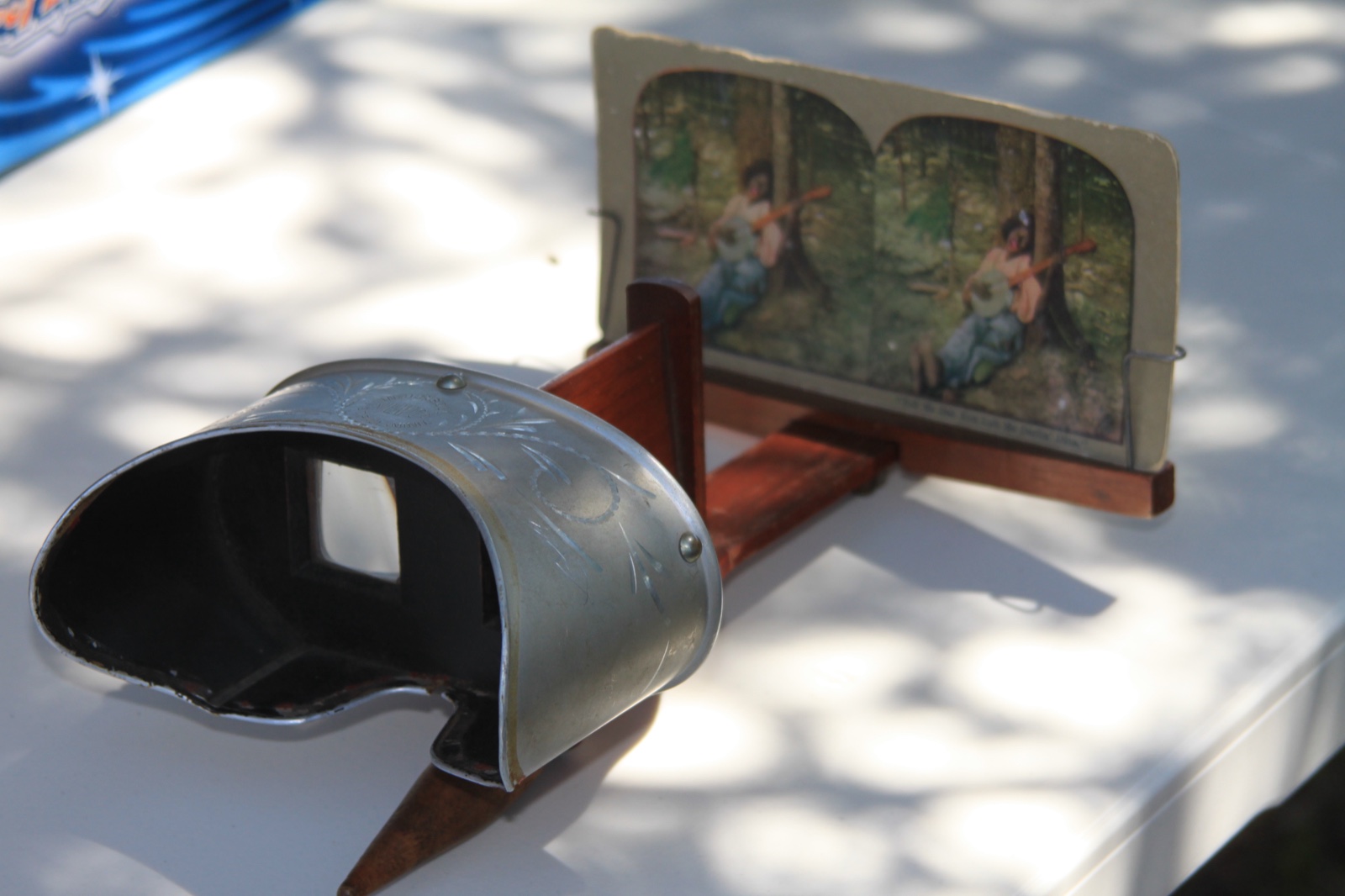
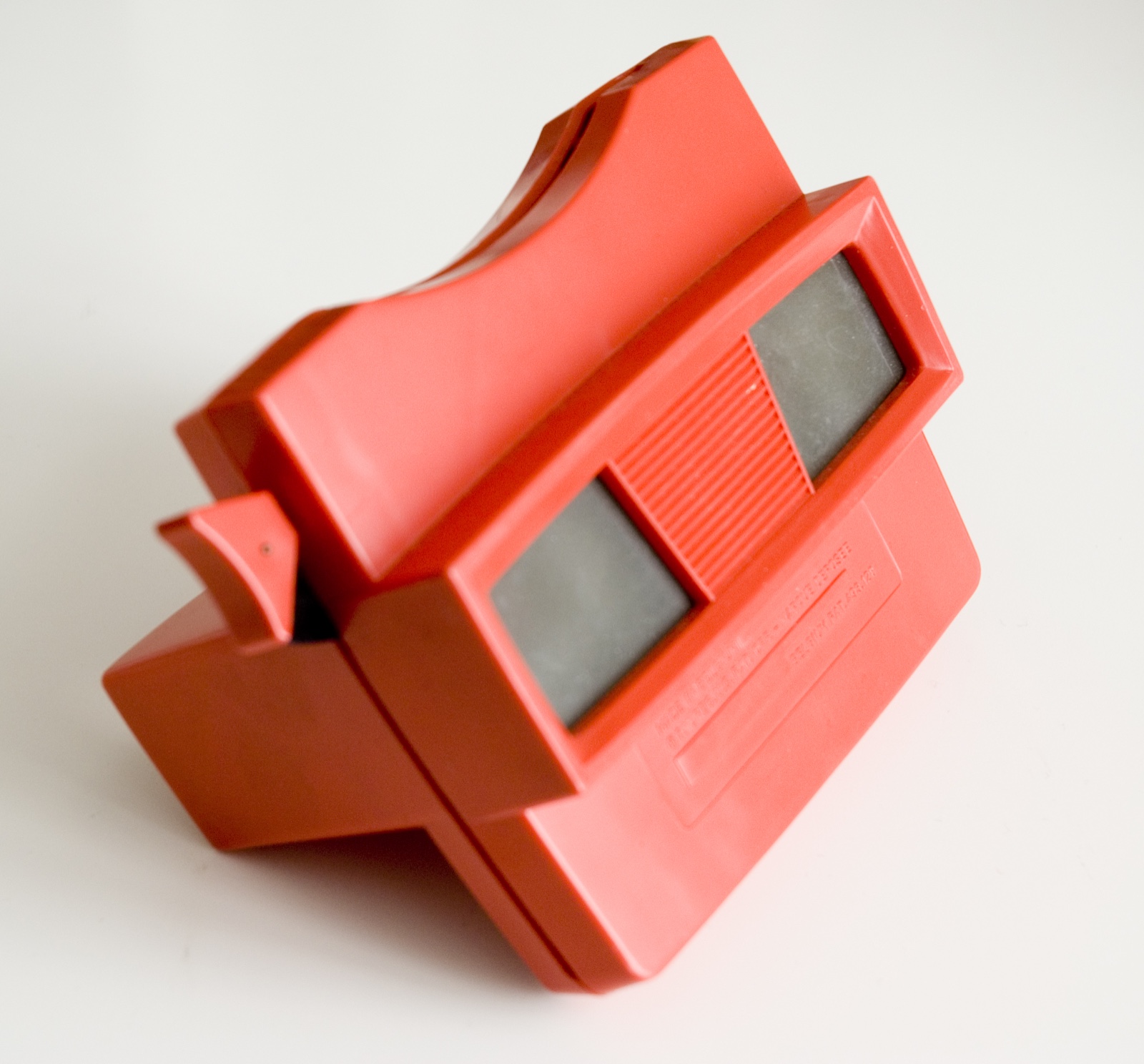
The whole idea in one object: a card with two nearly identical photographs, and a viewer that shows one to each eye. Photo: Ben Franske, CC BY-SA 4.0, via Wikimedia Commons.
Key takeaways
- "Stereoscopic" and "3D" are not the same word. "3D" also covers computer graphics shown on a flat screen; "stereoscopic" is only for pictures that give each eye its own view; see is stereoscopic the same as 3D.
- The depth comes from the small sideways difference between the two pictures, the same difference your two eyes see across a gap of about 6 cm; see how two flat pictures make depth.
- Stereoscopic depth is made in the brain from two eyes' pictures. For what the sources say about seeing with one eye, and what they do not say, see does it work with one eye.
- A "Stereoscopic 3D" setting in a game or player sends out two views. It does nothing useful without a 3D display, glasses or a headset to deliver one view to each eye; see the setting.
- A film can be shot with two cameras or converted from 2D afterwards. Software can also convert a 2D video file you have the right to use; that is an AI conversion, not the studio's 3D version; see shot or converted.
What does stereoscopic mean?
The Oxford Advanced American Dictionary gives the word two senses. Of a picture or photograph: "that is made so that you see the objects in it with length, width, and depth when you use a special machine", with "three-D" as a synonym. Of sight: "able to see objects with length, width, and depth, as humans do" [2].
Both senses rest on the same thing: two views of one scene. A primer on stereoscopic 3D written by two senior editors at the broadcaster BSkyB defines stereoscopic as "Concerned with, or relating to, seeing space three-dimensionally as a result of binocular disparity" [3]. Binocular disparity is the difference between what the left eye and the right eye see, caused by the horizontal distance between them [1].
The word comes from Ancient Greek: stereós, "firm, solid", and skopéō, "to look, to see" [1]. So a stereoscopic picture is, literally, one you see as solid. The noun is stereoscopy, and one stereoscopy blog sums it up in a sentence: "Stereoscopy uses the illusion of depth to create a single 3-D image from two flat images when viewed by each eye separately" [4].
Is stereoscopic the same as 3D?
No. Every stereoscopic picture is called 3D, but much of what is called 3D is not stereoscopic.
The BSkyB primer puts the split in two lines. "3D in film/television traditionally refers to computer-generated images (CG or CGI) using 3D models." Stereoscopic 3D, which the primer shortens to S3D, is the kind that creates the illusion of depth "when viewed on appropriate displays" [3].
So an animated film or a video game built from 3D models is "3D" in the first sense even on an ordinary screen, where both eyes see the same flat picture. It becomes stereoscopic only when each eye is shown its own view.
Three words that get mixed up with it:
- Stereographic is a different word. Asked on a panorama photographers' forum in November 2016 whether the two were the same, a member replied: "stereoscopic and stereographic are totally different things, stereoscopic refers to “3D” stereo vision, stereographic refers to a flat image projection like a little planet" [6].
- VR is often stereoscopic, but not always. A headset can show two-view stereoscopic imagery [1]. The same forum member pointed out that one panorama shown to both eyes in a VR viewer is a sort of “false stereo”, and that it takes two panoramas, one per eye, for true stereo [6].
- A hologram is not stereoscopic 3D. Presenting two flat images is "distinctly different from displaying an image in three full dimensions" with a volumetric display or by recreating a light field [1]; see how a hologram differs from 3D.
How do two flat pictures make depth?
Your eyes sit about 6 cm apart, so each sees the scene from a slightly different angle, and the brain combines the two views to judge distance [3]. John Daro, who has worked on the post-production of 3D films, gives the average distance between the pupils as 64 mm [5]. A stereoscopic picture copies the arrangement: two cameras record the scene from two positions about as far apart as the eyes, and on playback the left image is shown only to the left eye and the right image only to the right [3].
You can see the raw material yourself. Hold a finger about 3 inches from your face and close one eye, then the other. The finger jumps from side to side, and, as Daro puts it, "You also see “around” your finger more in one eye vs the other" [5]. That offset is what the brain turns into depth.
What puts an object in front of the screen or behind it
On a 3D screen, where an object seems to sit depends on how far apart its left-eye and right-eye images are drawn. The trade calls that separation parallax [3].
| The two images of an object | Where it appears [3] |
|---|---|
| In the same place on the screen | At the screen |
| Left-eye image shifted left, right-eye image shifted right | Behind the screen |
| Left-eye image shifted right, right-eye image shifted left | In front of the screen |
Drag the slider to see it happen.
Why two flat pictures look deep
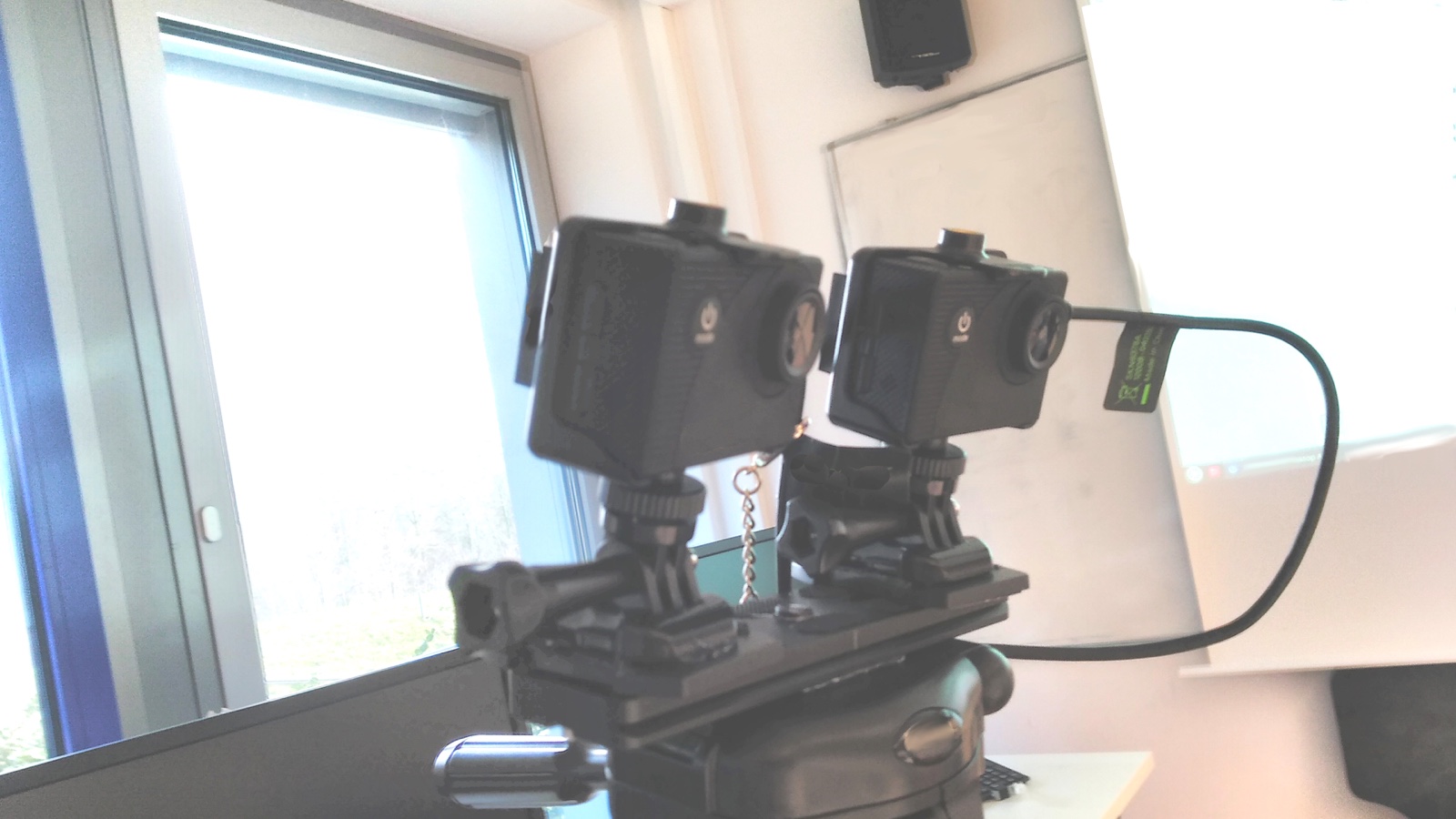
Film crews control this with two settings. The distance between the two cameras sets how much depth is captured: the wider apart, the more depth. The point the cameras converge on sets which objects land at the screen, in front of it or behind it [3].
Why you still sense depth with one eye closed
The difference between the two eyes' pictures is one item on a list. Wikipedia's article on stereoscopy lists the cues the brain uses to gauge distance and depth. Binocular disparity comes first; further down are occlusion ("the overlapping of one object by another"), the visual angle of "an object of known size", linear perspective, and haze [1]. All but the first three cues on the list, the article notes, "exist in traditional two-dimensional images, such as paintings, photographs, and television" [1].
The BSkyB primer says the same of a filmed scene: binocular disparity is processed by the brain "together with other information in a scene, including the relative size of objects, occlusion, shadows and relative motion" [3].
Does stereoscopic 3D work if you see with one eye?
The sources define stereoscopic depth as something made from two eyes' pictures. Stereo vision is, in the BSkyB primer's words, "a result of good binocular vision, wherein the separate images from two eyes are successfully combined into one 3D image in the brain" [3]. Wikipedia describes the method the same way: the left image is presented to the left eye, the right image to the right eye, and "the human brain perceives the images as a single 3D view" [1].
That two-eye difference is one depth cue on a longer list. Wikipedia notes that all but the first three cues on its list "exist in traditional two-dimensional images, such as paintings, photographs, and television" [1]; the list is under why you still sense depth with one eye closed.
Our guide to 3D without glasses has a section on one working eye, a squint or a lazy eye, which quotes an optometry professor.
What two viewers report
These are comments left under a Scientific American video on how 3D glasses work [7]. They are two people's own accounts of their own sight, not findings of ours, and we have not tested them.
- A commenter who describes having monocular vision, about 2021: "These types of movies never worked for me. I have monocular vision. I only see with one eye at a time, never both at the same time." [7]
- A commenter who is blind in one eye, about the start of 2026: "and if you are blind in one eye like me, then you don't get to see the movie in 3D." [7]
Ways to give each eye its own picture
Every stereoscopic system has the same job: get the left picture to the left eye and the right picture to the right eye [1]. They differ in how.
| Method | How each eye gets its picture | What you wear | Our guide |
|---|---|---|---|
| Anaglyph | The two images are tinted, typically red and cyan, and laid over each other; coloured filters sort them [3] | Red-cyan glasses | Anaglyph 3D |
| Polarized (passive) | Each image is polarized differently and both are shown together; each lens blocks the other eye's image [3] | Glasses with no battery [3] | Polarized glasses |
| Active shutter | The screen alternates left and right images; LCD lenses black out each eye in time with it [3] | Battery-powered glasses [3] | Active shutter glasses |
| Headset | Two small displays with magnifying lenses, one for each eye [1] | The headset | Movies in VR |
| Glasses-free (autostereoscopic) | Optics in the display, not worn by the viewer, send a different image to each eye [1] | Nothing | 3D without glasses, lenticular screens |
| Stereoscope | Two photographs taken from slightly different angles, presented one to each eye [1] | Nothing; you look into the viewer | History |
| Free-viewing | A side-by-side pair viewed with no device, by aiming the eyes parallel or crossed [1] | Nothing | Try it |
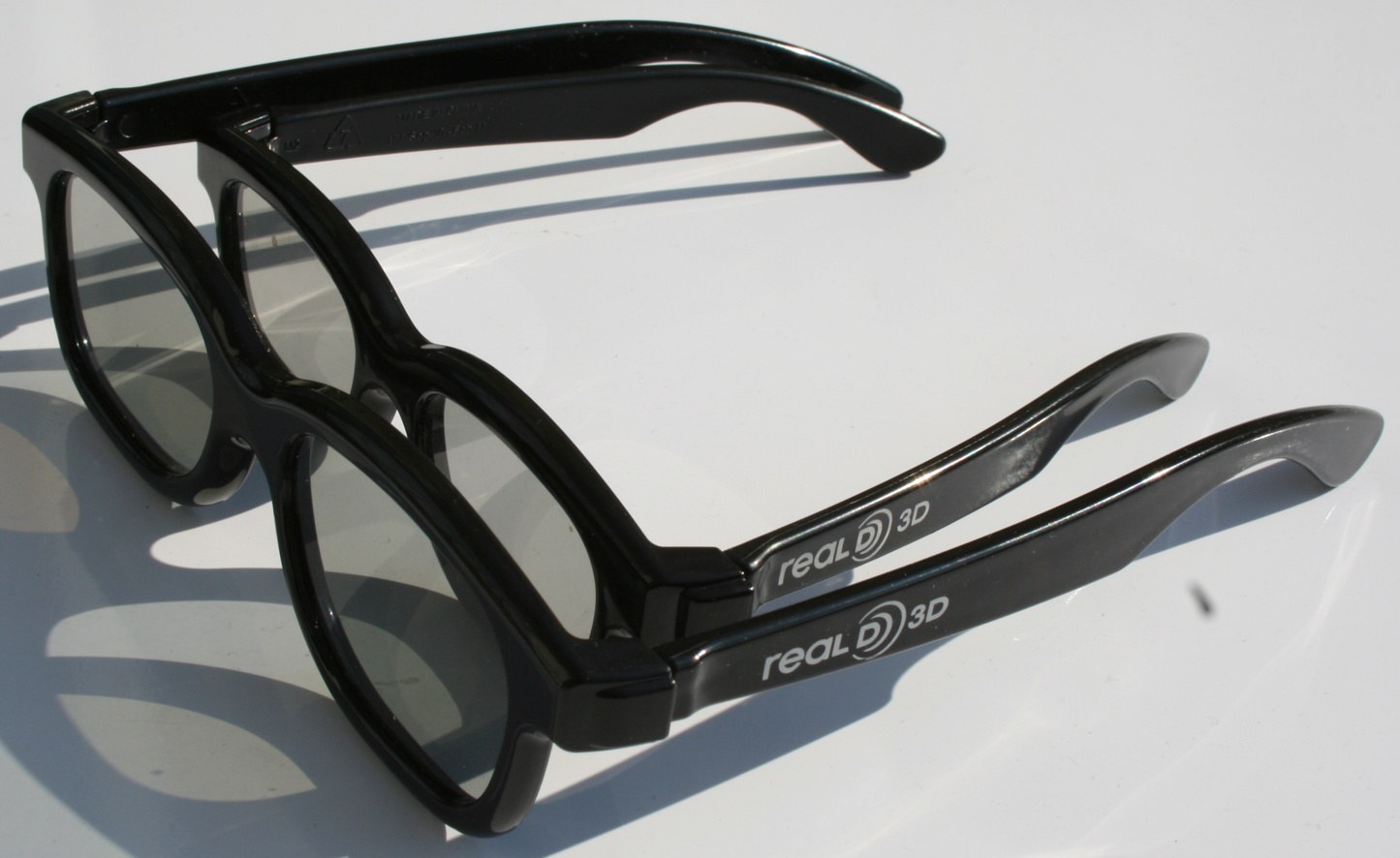
Anaglyph, polarized and shutter are all stereoscopic; they are three ways of sorting the same two pictures. For how the glasses compare, see how 3D glasses work.
Because a glasses-free screen aims its images, the viewer's head has to be in a position where each eye receives the right one. One class of these displays uses head-tracking to keep each eye on its own image [1]. Owl3D, the publisher of this guide, makes the Shift. The Owl3D Shift is a glasses-free lenticular display that tracks the eyes: an eye-tracking camera follows the viewer, and the display steers the left-eye and right-eye images to where the eyes are, for one viewer at a time.
A stereoscopic video also has to be stored and sent. One way, used in broadcasting, is side-by-side (SBS): the left-eye and right-eye images are squeezed into the two halves of one frame, and the viewing device expands them again [3]; see 3D video formats.
Shot in stereo or converted to 3D: what is the difference?
A stereoscopic film gets its two pictures in one of two ways. Shot in stereo, two matched cameras record both eyes' views on set [3]. Converted, the film is shot in 2D and the 3D is made afterwards, in post-production [8].
Why convert, when two cameras capture real depth? On the Movies & TV Stack Exchange in October 2014, someone asked exactly that, calling conversion "creating a shallow 3d effect via post processing". The answer, from another member and not an industry document, gave cost and practicality: "Shooting in 3D costs are said to be 2-4 times that of 2D costs", and, quoting Wikipedia's article on 2D to 3D conversion, "Professional stereoscopic rigs are much more expensive and bulky than customary monocular cameras" [8].
The BSkyB primer shows the same burden from the inside. The two cameras must match in geometry, exposure, colour balance, focus and zoom. Large cameras are hard to place close enough side by side, so a second kind of rig sets one camera horizontally and the other vertically around a semi-transparent mirror, which is fragile and costs a stop of light. And a 3D project means "double the recorded material, double the required disc space for storage, and double the rendering time" for stereoscopic adjustments [3].
The cardboard cut-out look has a name in the trade, card boarding, and the primer's glossary puts it down to camera spacing: "Usually the result when the interocular distance of the viewer exceeds the interaxial distance, giving a cardboard cut-out effect" [3]. Interaxial is the distance between the two camera lenses [3].
Making a 2D video stereoscopic yourself
Software can convert a video that was shot with one camera into stereoscopic 3D. Owl3D, the publisher of this guide, makes such a program. The Owl3D desktop app, for Windows and Mac, converts 2D videos and photos into stereoscopic 3D using AI, and the processing runs on your own computer.
It is an AI conversion, not the studio's 3D version, and not footage shot with two cameras. It is not instant: you give it a video file you have the right to use, and it takes time. It exports four formats: Side-by-side, Half Side-by-Side, Top-Bottom, and Spatial Video for Apple Vision Pro, the last on the Mac only. Side-by-side or half side-by-side suits VR headsets, 3D TVs and projectors. The app has a free tier and paid plans; see pricing.
From Owl3DOwl3D converterA desktop app for Windows and Mac that turns 2D videos and photos into 3D.What does the "Stereoscopic 3D" setting do in a game or a video player?
In a game, it makes the game produce two views of the scene, one for each eye [9]. The two views turn into depth only when something delivers one to each eye [1]. On an ordinary monitor with nothing to wear, there is nothing to do that, so leave the setting off unless you have a 3D display, a 3D projector or TV with its glasses, or a headset; the table above lists the kinds.
Does it halve the frame rate? Members answering that question on the Game Development Stack Exchange in 2010 disagreed. The accepted answer said "In short, yes you will need to be outputting 60fps to have the effect of 30fps." A higher-voted answer said the opposite: "You do not lose half your performance when turning on stereo 3d", because "Only the rendering is done twice" while game logic, AI and physics run once. A third said one engine builds the second view from the first, so "the performance drop is 5-10% when turning on 3D" [9]. These are statements about 2010 hardware and engines.
It is switched on and nothing changes. One player's report, from a game's Steam forum in May 2017: "If I enable Stereoscopic 3D in the Options it tells me to manually restart the game but it doesn't actually take effect next time I launch it". The player got it working with Nvidia 3D Vision only after forcing the game into exclusive fullscreen with a third-party tool, and wrote that "there's so much more depth than in anaglyph mode". A reply in the thread thanked the player for reporting it [10]. This is one person's account and we have not tested it. For what works on a PC today, see five ways to play PC games in 3D.
With video, the two pictures arrive packed into each frame, for example side by side, and the viewing device has to expand them again and send one to each eye [3]; see 3D video formats.
Try it: a stereo pair you can see without a device
Free-viewing means fusing a side-by-side pair with your eyes alone. There are two ways, parallel and cross-eyed [1]. The pair below is laid out for the cross-eyed way: the left-eye picture is on the right and the right-eye picture is on the left [1].

- Hold up a fingertip. Place it just below the line where the two pictures meet [1].
- Bring it toward your eyes. Move it slowly, keeping your eyes on the fingertip [1].
- Watch the pictures behind it. At a certain distance a fused, three-dimensional picture should seem to hover just above the finger [1].
If the flower's depth looks inside out, you are viewing it the parallel way: "If you parallel view an image meant for cross-eye viewing (or vice versa), the depth is reversed" [11].
Some people take a long time to learn this, and some cannot do it at all, the tutorial's author writes [11]. For both methods in more detail, see free-viewing.
A short history of stereoscopic pictures
Stereoscopic pictures are a year older than photography [12].
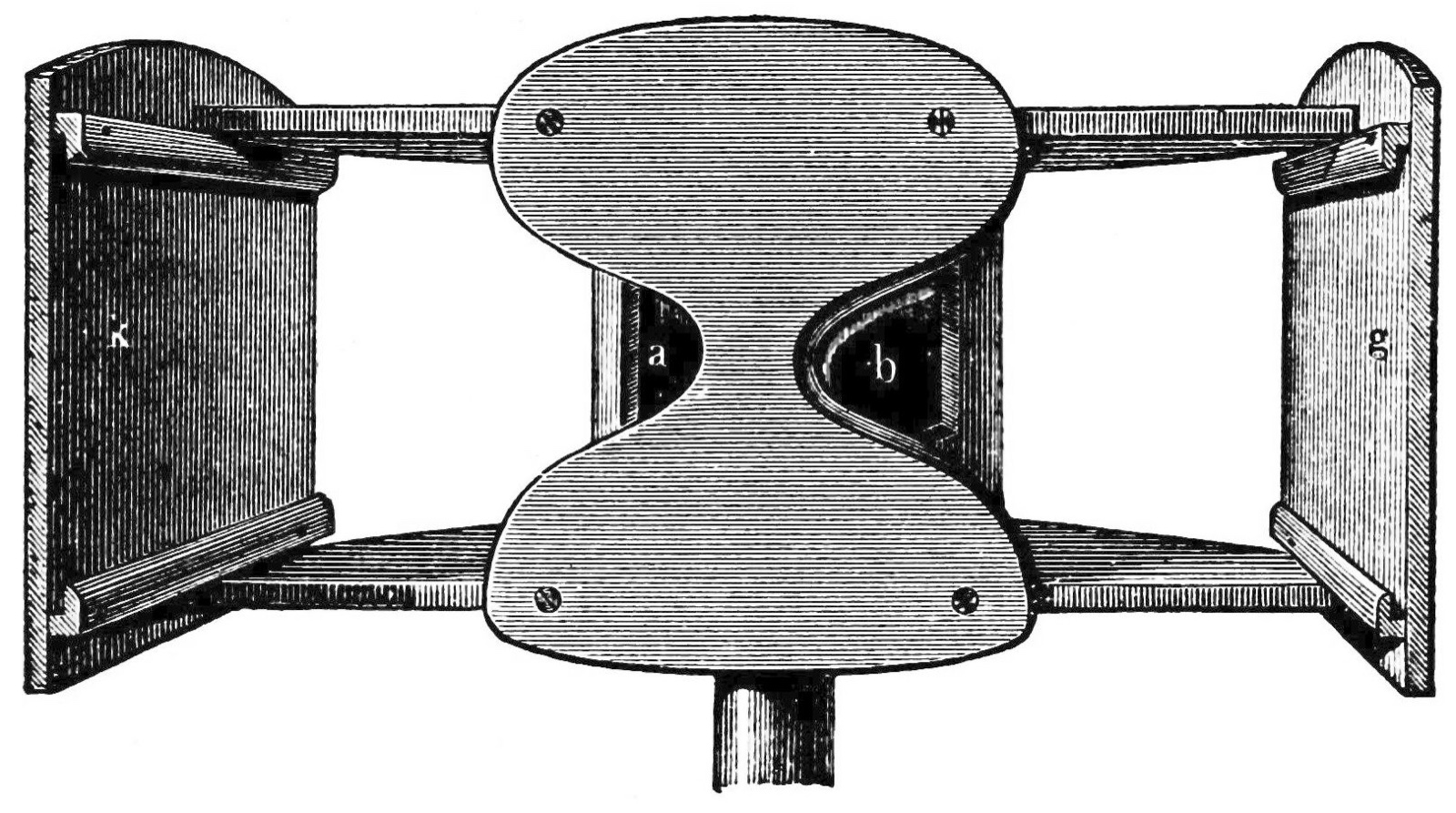
- 1838. Charles Wheatstone described stereoscopic vision "in a paper read to the Royal Society on 21 June 1838", and built a stereoscope with two mirrors to show pairs of line drawings as one image in relief [12].
- 1839. Photography arrived a year later and turned the stereoscope into "a popular parlour entertainment" [12].
- 1849. David Brewster improved and popularised a portable viewer that used lenses and prisms instead of mirrors. It gained mass popularity after the Great Exhibition of 1851 [12].
- 1939. View-Master was introduced; Wikipedia describes it as "still in production" [1].
- Cinema. The first practical 3D filming and viewing system came from Edwin Land, "nearly a century after stereo photography", with polarized glasses worn by the audience [12].
Frequently asked questions
What is a stereo image?
A stereoscopic image, also called a stereogram: originally a pair of two-dimensional pictures made to be viewed in a stereoscope [1].
Is anaglyph the same as stereoscopic?
Anaglyph is one kind of stereoscopic picture. The BSkyB primer defines it as "A type of stereoscopy in which the two pictures are individually coloured and then superimposed as a single image" [3]; see anaglyph 3D.
Is side-by-side (SBS) the same as stereoscopic 3D?
Side-by-side is a way of packing a stereoscopic picture into one frame, not a different kind of 3D [3]; see 3D video formats.
Do humans have stereoscopic vision?
Yes, in the dictionary's sense: "able to see objects with length, width, and depth, as humans do" [2]. It depends on the two eyes working together [3].
What are the drawbacks of stereoscopic 3D?
Two that reference works name. Your eyes focus on the screen while they converge on objects that seem nearer or farther, which Wikipedia calls the vergence-accommodation conflict [1][3]. And some of one eye's image can leak into the other, called crosstalk or ghosting [1][3]. If 3D gives you headaches, see what to try at a 3D showing.
Why does a video look 3D with sunglasses over one eye?
That is the Pulfrich effect. The eye processes images more slowly when there is less light, as when looking through a dark lens. The effect depends on motion in a particular direction, so "it is not useful as a general stereoscopic technique" [1].
Sources (12)
- Wikipedia, "Stereoscopy". https://en.wikipedia.org/wiki/Stereoscopy (opened 2026-10-10)
- Oxford Learner's Dictionaries, "stereoscopic", definition from the Oxford Advanced American Dictionary. https://www.oxfordlearnersdictionaries.com/definition/american_english/stereoscopic (opened 2026-10-10)
- Simon Reeve and Jason Flock, Senior Editors, BSkyB, "Basic Principles of Stereoscopic 3D" (PDF, 27 pages, hosted by Newcastle University; no publication date, copyright line 2010). https://www.ncl.ac.uk/media/wwwnclacuk/pressoffice/files/pressreleaseslegacy/Basic_Principles_of_Stereoscopic_3D_v1.pdf (opened 2026-10-10)
- The Stereoscopy Blog, "What is Stereoscopy?", by Rebecca, June 9, 2019. https://stereoscopy.blog/2019/06/09/what-is-stereoscopy/ (opened 2026-10-10)
- Lowepost, "Beginners Guide to Stereoscopic Understanding", by John Daro (the free excerpt). https://lowepost.com/insider/workflow/3d-a-beginners-guide-to-stereoscopic-understanding-r69/ (opened 2026-10-10)
- IVRPA forum, "Stereo Panoramas: 2D vs 3D ?", November 2016 (forum members' posts). https://ivrpa.org/forums/topic/stereo-panoramas-2d-vs-3d/ (opened 2026-10-10)
- YouTube, Scientific American, "How Do 3D Glasses Work? - Instant Egghead #22" (viewers' comments; users' reports). https://www.youtube.com/watch?v=sc47Yna8rZE (opened 2026-10-10)
- Movies & TV Stack Exchange, "Why not shoot movies with stereoscopic 3d cameras instead?", October 2, 2014 (members' question and answer). https://movies.stackexchange.com/questions/24983/why-not-shoot-movies-with-stereoscopic-3d-cameras-instead (opened 2026-10-10)
- Game Development Stack Exchange, "How much extra power is required for a stereoscopic 3D game?", July to August 2010 (members' answers). https://gamedev.stackexchange.com/questions/591/how-much-extra-power-is-required-for-a-stereoscopic-3d-game (opened 2026-10-10)
- Steam Community, Rocket Riot discussions, "So what's up with Stereoscopic 3D\3D Vision Support?", May 8, 2017 (a player's report). https://steamcommunity.com/app/460190/discussions/0/1327844097125671323 (opened 2026-10-10)
- The Stereoscopy Blog, "Learning to Free-View: See Stereoscopic Images with the Naked Eye", by Sroyon Mukherjee, March 11, 2022. https://stereoscopy.blog/2022/03/11/learning-to-free-view-see-stereoscopic-images-with-the-naked-eye/ (opened 2026-10-10)
- The Royal Society on Google Arts & Culture, "Stereoscopy: the birth of 3D technology". https://artsandculture.google.com/story/stereoscopy-the-birth-of-3d-technology-the-royal-society/pwWRTNS-hqDN5g?hl=en (opened 2026-10-10)