What Is a Hologram? Definition, Meaning and How Holograms Work
How we researched this: written by Owl3D from published sources, all 50 listed at the end.
Short answer
A hologram is a three-dimensional image recorded on a flat surface, usually with laser light. You see the object with real depth, and from a different side when you move your head, as if it sat behind a window, with no glasses needed.
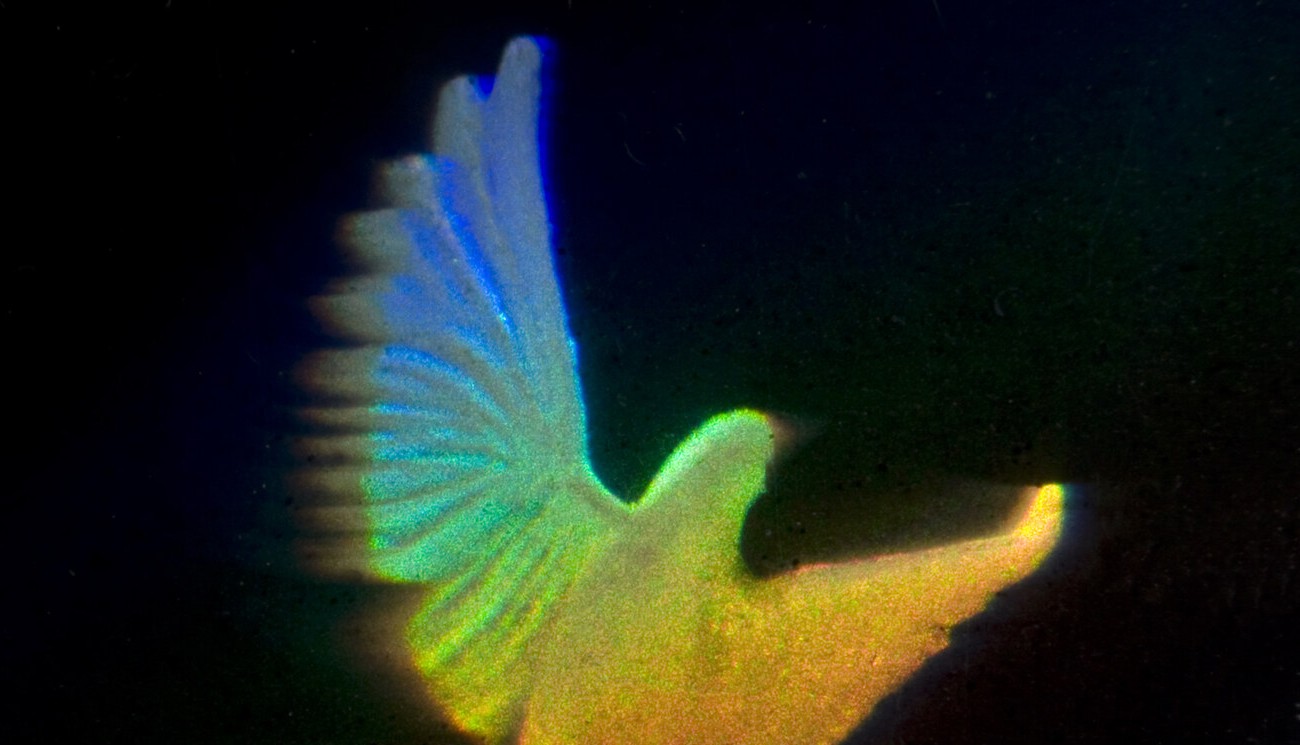
A real hologram, of the kind this page defines: the dove on a Visa credit card. Photo: Dominic Alves, CC BY 2.0, via Wikimedia Commons; cropped.
Key takeaways
- Real holograms exist, and the shiny patch on a credit card is one; see holograms today.
- The movie hologram, a figure standing in open air that you can walk around, is not one, and a stage "hologram" of a performer is a flat video image, in the classic version reflected off clear film; see what gets called a hologram.
- On consumer products, "hologram" and "holographic" are mostly marketing words for several different technologies; see is it a marketing term.
- A hologram stores the light waves that came off an object as a microscopic pattern, which bends light back into a copy of those waves [1][2]. Dennis Gabor had the idea in 1947 and made the first holograms in 1948; see how holograms work and who invented it.
- 3D at the movies, in a headset or on a glasses-free screen is not a hologram: it is two flat images, one for each eye; see hologram vs 3D, where the Owl3D Shift is the worked example.
Hologram definition and meaning
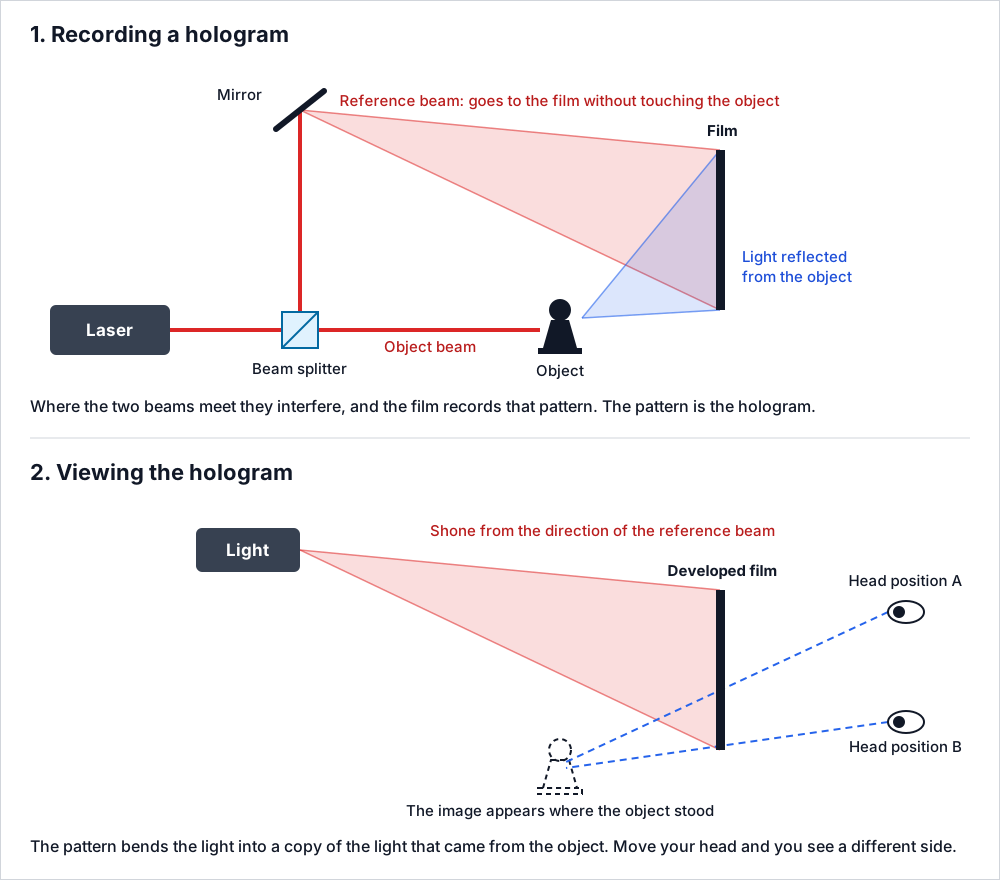
In everyday terms, a hologram is, as Longman's dictionary puts it, "a kind of photograph made with a laser that looks as if it is not flat when you look at it from an angle" [9].
The precise definition is about how the image is made. The Center for the Holographic Arts puts it in one sentence: "A hologram is a physical structure that diffracts light into an image" [1]. To diffract is to bend and spread light waves as they pass very fine detail. In a hologram that detail is a pattern too small to see, recorded in film or stamped into a surface. It is called an interference pattern, because it forms where two beams of light meet (see how holograms work).
This diagram was made by Owl3D. It may be downloaded and reused free of charge with credit to Owl3D.
The related words:
| Word | What it means |
|---|---|
| Hologram | The result: both the recording and the image you see in it [1] |
| Holography | The method |
| Holographic | Made by holography |
| Holograph | A different and much older word, for a document handwritten by its author [10]; see what a hologram will is |
The word comes from Greek. Dennis Gabor, the inventor, said he named it from holos, the whole, "because it contained the whole information" [3]. The second half is gramma, "message" [11].
In everyday speech the word is also used far more loosely, for almost any picture that seems to float and almost anything with a rainbow shimmer. The "holographic" foil on stickers and cards, for example, is an embossed groove pattern that splits white light into colors, with no image stored in it [12].
Do holograms exist today? Hologram technology in 2026
Yes, in two forms: still holograms, which are common, and moving holographic displays, which are at an early stage.
Still holograms are common
The hologram on a credit card is a rainbow hologram, a type that can be mass-copied and viewed in ordinary white light [5]. It is embossed, meaning stamped from a master hologram, and embossed holograms are used on passports, credit cards, tickets and packaging because they are very difficult to copy without the master [14].
Where still holograms are used: cards, banknotes, art and kits
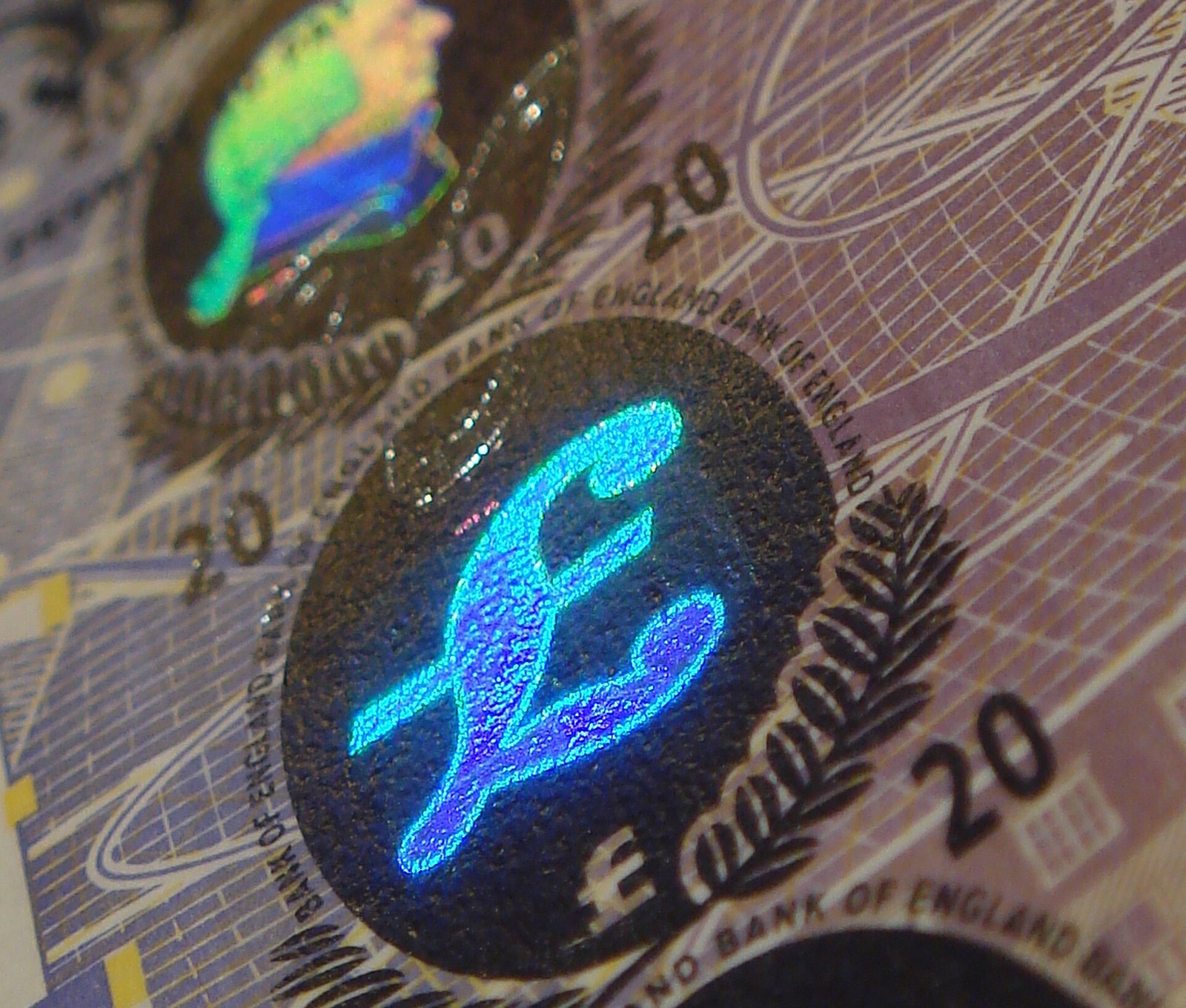
Moving holograms are at an early stage
In a holographic display nothing is recorded from a real object. A computer calculates the interference pattern, and laser light diffracts through it to form the image [25].
As of October 2026, we found displays described as working this way only among research prototypes and car head-up displays, and no TV, monitor or phone screen.
Two examples: a Stanford headset prototype and Envisics car head-up displays
Is "hologram" just a marketing term?
In optics, no. On consumer products, mostly yes.
The scientific term is precise. A hologram forms its image by diffraction from a recorded or computed interference pattern. Holograms in that sense are made and sold today, as the section above shows.
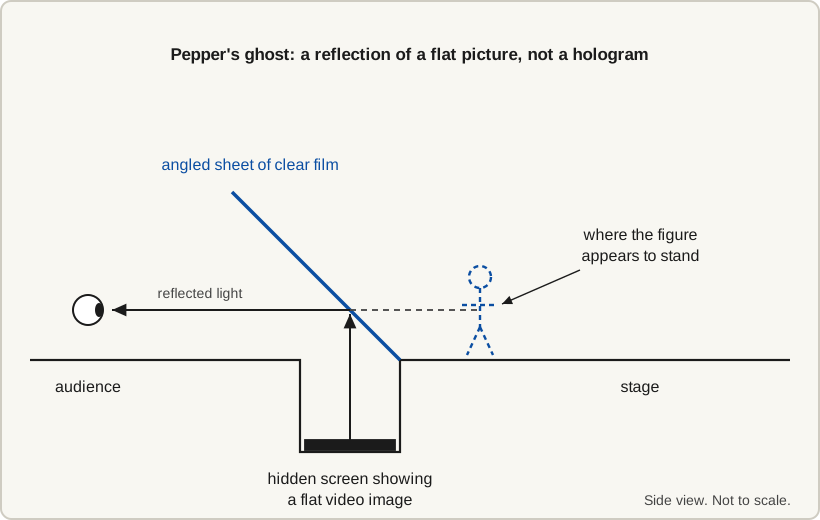
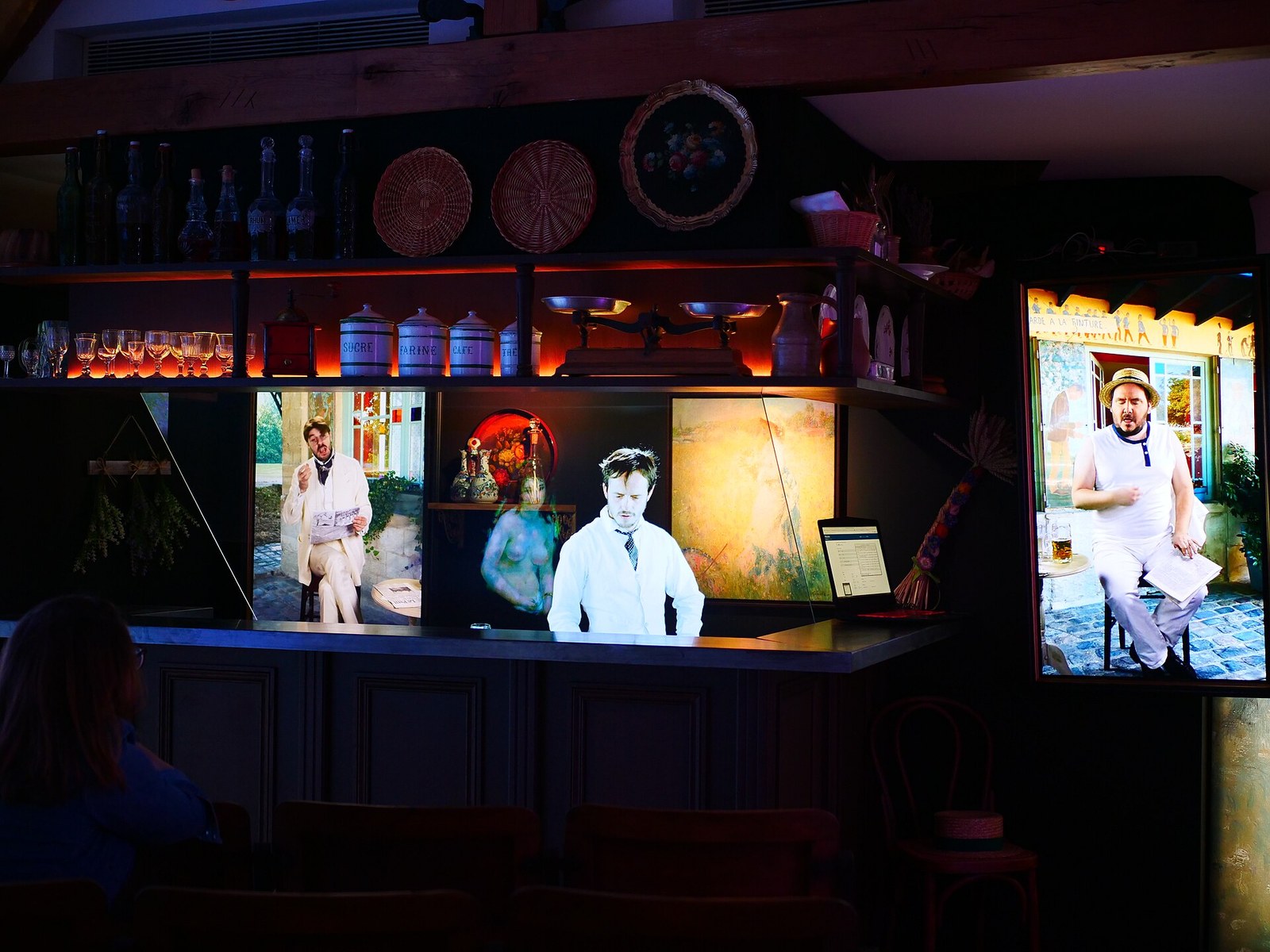
The marketing use is not. "Hologram" and "holographic" are put on stage projections, spinning LED fans and multi-view 3D screens [1][27][28]. These work in different ways. What they share is a picture that looks three-dimensional or seems to float.
One maker of LED-fan displays says so itself: commercial "holographic" displays, instead of "creating a traditional photographic hologram", use other techniques "to create the perception of a three-dimensional image" [27].
The standards definition, and why nothing stops the loose use: standards, advertising law and a UK ruling
The International Electrotechnical Commission (IEC), which writes the international standards for electronic displays, defines a holographic display the same way, by diffraction: a "three-dimensional display that generates light converging to each point of a three-dimensional image in space by light diffraction" [26].
Nothing makes anyone use the words precisely. The standards that define them are voluntary documents for measuring displays, not rules about what a product may be called. The IEC "does not provide any attestation of conformity" [26], and the display industry's own measurement standard "does not set compliance values for any of its measurements" [30].
US advertising law asks that an ad be "truthful, not misleading" [31], and we found no rule on what may be called a hologram. In 2012 the UK's Advertising Standards Authority considered a complaint about an ad for a "3D holographic projection" stage system, which reflects video off a foil. It noted that the effect "did not use holography" and still ruled the ad not misleading, because viewers "would not interpret the claims literally" [32].
So when something is sold as a hologram, the useful question is how it makes its image.
What gets called a hologram, by technology
Seven technologies get called a hologram, and two of them are holography in the scientific sense.
| Technology | How it makes its image | Holography in the scientific sense? |
|---|---|---|
| Recorded hologram (on film, glass or embossed foil) | Light diffracts from a recorded interference pattern and rebuilds the object's light waves [15][33] | Yes |
| Computer-generated holography (research headsets, some car head-up displays) | A computer calculates the interference pattern, and laser light diffracts through it [25][7] | Yes |
| Pepper's ghost (stage "holograms", phone pyramids) | A flat video image reflected off an angled sheet of clear film or plastic; first performed in London in 1862 [34][35][36] | No: a reflection of a flat picture |
| Spinning LED fan | LEDs on fast-rotating arms light up at timed positions, and the eye sees one floating picture [27] | No: a flat picture drawn over time |
| Glasses-free 3D screen (lenticular lenses or a parallax barrier) | A lens or barrier layer over the panel sends a different image to each eye; some models track the viewer's eyes with a camera [37][38] | No: stereoscopic 3D |
| Multi-view or "light field" screen | Many views sent in different directions, up to 100 in one maker's documentation [28][39] | No: views, not rebuilt light waves [29] |
| Volumetric display | Points of light drawn inside a real volume, for example on a fast-spinning LED array or on a particle moved by lasers [40][16] | No, though the image can be seen from any side |
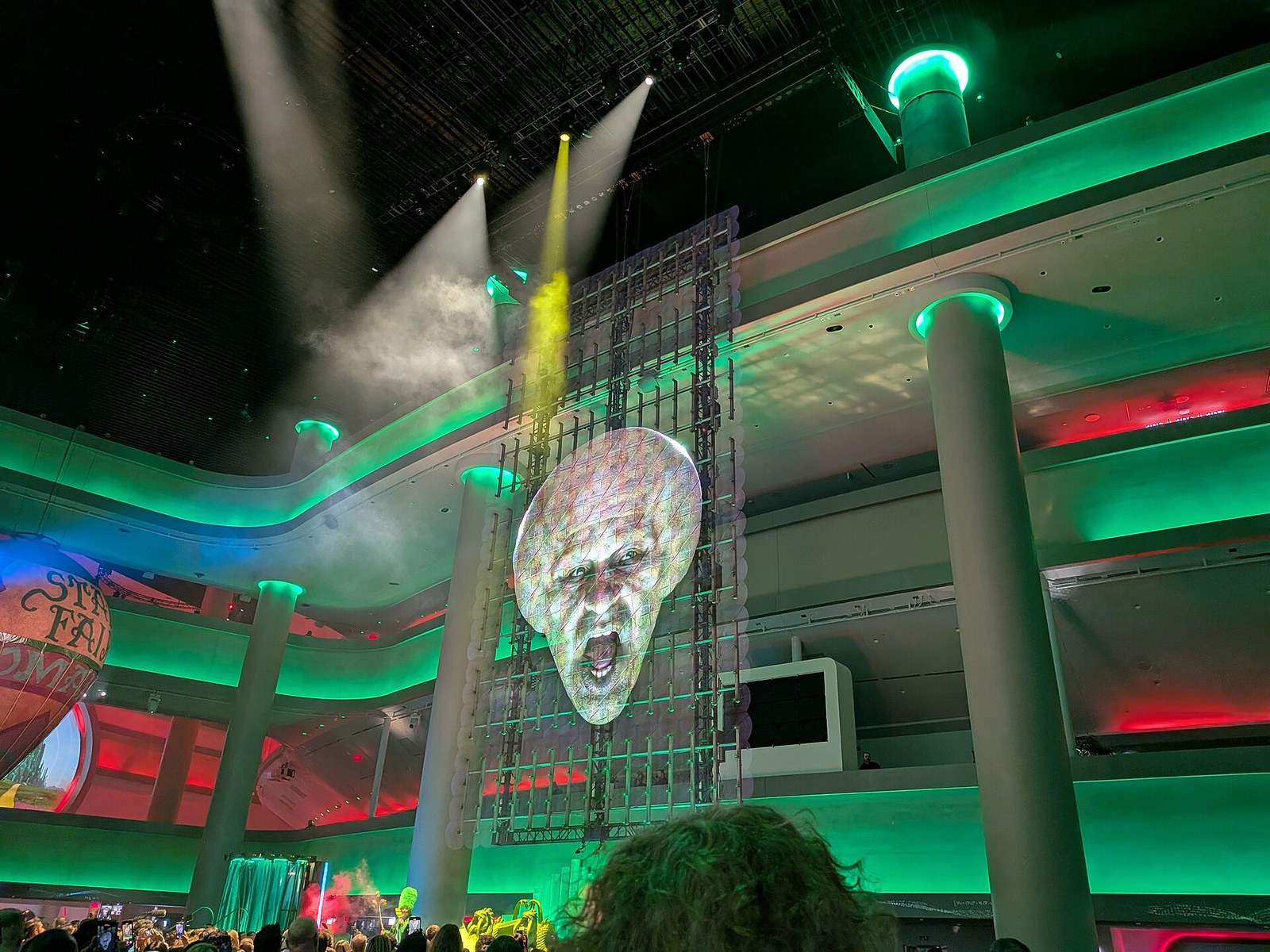
On a multi-view screen each eye gets a different view, and the picture shifts as you move [28][39].
How do holograms work?
A photograph records how bright the light was at each point. A hologram records both the brightness and the phase of each light wave [2]. Phase is where a wave is in its up-and-down cycle when it arrives. It carries the information about direction and distance that a photograph throws away.
The classic way to record a hologram, shown in the diagram under the definition [2][13]:
- Split the beam. A laser beam is split in two. Laser light is coherent, meaning its waves stay in step with each other.
- Light the object. One half, the object beam, lights the object and reflects off it onto a piece of film.
- Send the reference beam. The other half, the reference beam, goes to the film without touching the object.
- Record the pattern. Where the two beams meet they interfere: the waves add up in some spots and cancel in others. The film records that interference pattern, which is too small to see [14].
To view it, you shine light on the developed film from the direction the reference beam came from [13]. The pattern diffracts the light into a copy of the waves that came from the object.
Looking through the film, you see the object in three dimensions at the place where it stood, and it changes appearance when you look from a different angle, as the real object would [15]. That change of view as you move is called parallax.
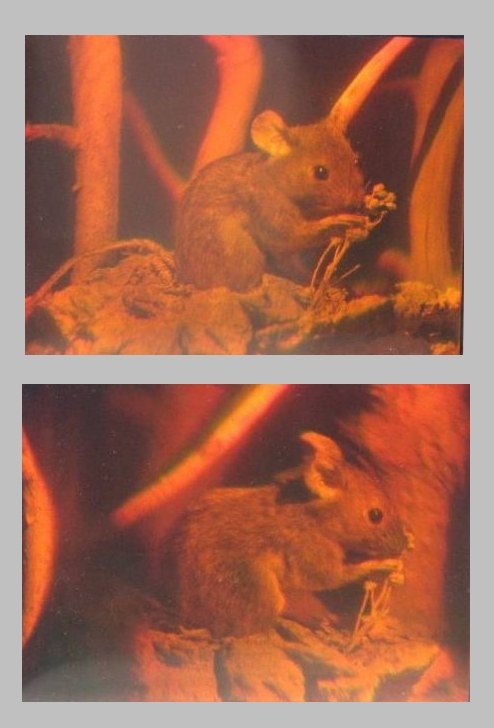
Two consequences follow:
- Every piece holds the whole picture. "You can cut off the corner of a hologram and see the entire image through it" [15].
- A hologram needs a surface. The depth is real, but you only see it while looking at or through the plate [16]. It does not hang a picture in open air.
Who invented the hologram?
Dennis Gabor invented the hologram. He had the idea in 1947, and made and published the first holograms in 1948, which is why some references give one year and some the other.
Gabor, an engineer born in Budapest, was working at the British Thomson-Houston company in Rugby, England, and trying to improve the electron microscope [11][3]. He used a mercury lamp for the first experiments, because the laser did not exist yet [3][4][17]. Holography became practical after the laser arrived.
Timeline, 1947 to 1971: from Gabor's idea to the Nobel Prize
| Year | What happened |
|---|---|
| 1947 | The solution came to Gabor "one fine day at Easter 1947" [3] |
| 1948 | Gabor carried out the first experiments and published the method in the journal Nature in May [3][4][17] |
| 1960 | Theodore Maiman built the first working laser [19] |
| 1963 | Emmett Leith and Juris Upatnieks of the University of Michigan published the first successful laser holograms [3] |
| 1968 | Stephen Benton invented the rainbow hologram, the kind now seen on credit cards [20] |
| 1971 | Gabor received the Nobel Prize in Physics "for his invention and development of the holographic method" [18] |
How is a hologram different from 3D?
"3D" at the movies, on a 3D TV, in a VR headset or on a glasses-free screen means stereoscopic 3D: two flat images, one for each eye, which your brain fuses into depth (see types of 3D glasses). A hologram is not two images. It rebuilds the light itself, and two differences follow:
| Hologram | Stereoscopic 3D | |
|---|---|---|
| Moving your head | It gives "a shifting perspective based on the viewer's position" [2] | The same two views wherever you sit, unless the device tracks your head and redraws them |
| Focus | Your eye can refocus between the foreground and the background [2] | Your eyes focus on the screen whatever depth the scene suggests [41] |
Stereoscopic 3D is also the kind you can watch today (see how to watch 3D movies at home and where to find 3D videos).
Glasses-free 3D screens are stereoscopic too. The Owl3D Shift is a 14-inch glasses-free lenticular display, not a hologram: an array of cylindrical (lenticular) lenses sits on a 4K LCD panel, and an eye-tracking camera follows the viewer so that the display can steer a left-eye image and a right-eye image to where the eyes are. It shows 3D to one viewer at a time, and it needs a computer running the Owl3D app. Owl3D, the publisher of this guide, makes the Shift.
Owl3D does use the word for one feature: the Shift's 3D Photo Viewer is described as turning a photo into a "hologram". There the word means a 3D reconstruction of the picture's depth with strong motion parallax, so that the subject looks as if it were placed inside the display. It is not holography in the optical sense described on this page.
For how such screens work, see what a lenticular lens is, whether you can watch 3D without glasses and glasses-free 3D monitors compared.
From Owl3DOwl3D ShiftA 14-inch glasses-free 3D display that sits beside your computer.Frequently asked questions
What is a hologram will (a holographic will)?
Nothing to do with 3D images. The legal term is holographic will, and it means a handwritten will: "an unattested will that is written and signed in the testator's own handwriting" [50]. The name comes from "holograph", the old word for a document handwritten by its author [10]. Whether such a will is valid depends on the state, and some states do not recognize them at all [50]. This is not legal advice.
Is a hologram a real image?
Yes, in the everyday sense. A hologram is a real physical recording, and the depth in it is real optics, not a trick of perspective [15]. What is not there is the object.
In optics, "real image" has a narrower meaning: an image that forms on a screen, as opposed to a virtual image, which the eye can see but which does not [42]. A hologram can show either. Looking through it, you see the image behind the film, where the object stood [13], and a narrow laser beam sent through it projects a real image [43].
What is the purpose of a hologram?
Gabor's original purpose was scientific: sharper pictures from the electron microscope [3]. Today the most common purpose is security: the holograms on cards, banknotes and passports are there because they are hard to copy [5][6][14]. Others are made as art, used in industry to detect small changes in the shape of a part, made into optical parts that direct light in projection screens and augmented reality displays, and built into car head-up displays [23][25]. Holographic data storage is an old idea, and in 2020 Microsoft announced a research project to rethink it for cloud storage [44].
What is a hologram of a person?
On stage, a "hologram" of a performer or speaker is a video effect, not holography. The Tupac appearance at Coachella in 2012 was a 2D projection using the Pepper's ghost trick [45], and ABBA Voyage shows its avatars on a 65-million-pixel LED screen [46]. Each is a flat image arranged so that it looks like a person standing in the room. Real holograms of people exist too, as still portraits: a pulsed laser gives a flash short enough to record a live subject [23].
The word is also used for video calls. In September 2026 Meta announced what it calls "hologram technology" for its coming VR glasses: "a photorealistic digital version of you, including your real-time expressions and reactions, for hands-free video calling" [51]. By Meta's own description that is a rendered digital likeness shown on a display, not a recording of light waves.
Is the universe a hologram?
Nobody knows. It is an idea in theoretical physics, not an established fact, and it has nothing to do with lasers or 3D pictures. The holographic principle, proposed by Gerard 't Hooft and elaborated by Leonard Susskind in the 1990s, says that the physics inside a region of space might be completely described by a theory that lives only on the region's boundary, much as a flat hologram holds a three-dimensional scene [47]. Physicist Jacob Bekenstein wrote in Scientific American that for our own universe, "We do not yet know of any such 3-D theory that works in that way" [47].
Experiments have not settled it. Fermilab's Holometer experiment looked for the "holographic noise" that one such model predicts, and ruled that model out in 2015 [48]. A 2017 study found as much evidence in the afterglow of the Big Bang for a holographic explanation as for the standard one [49].
Sources (50)
- Holocenter (Center for the Holographic Arts), "What is a Hologram?", https://holocenter.org/what-is-holography/what-is-a-hologram, opened 2026-10-07
- MIT News, "Using artificial intelligence to generate 3D holograms in real-time" (March 10, 2021), https://news.mit.edu/2021/3d-holograms-vr-0310, opened 2026-10-07
- Dennis Gabor, "Holography, 1948-1971", Nobel Lecture, December 11, 1971, https://www.nobelprize.org/uploads/2018/06/gabor-lecture.pdf, opened 2026-10-07
- D. Gabor, "A New Microscopic Principle", Nature 161, pp. 777-778 (issue dated May 15, 1948), https://www.nature.com/articles/161777a0, opened 2026-10-07
- HyperPhysics, Georgia State University, "Rainbow Holograms" and "Hologram History", https://hyperphysics.gsu.edu/hbase/optmod/holog3.html, opened 2026-10-07
- Bank of England, "How to check your banknotes", https://www.bankofengland.co.uk/banknotes/counterfeit-banknotes/how-to-check-your-banknotes, opened 2026-10-07
- Stanford Electrical Engineering, "A leap toward lighter, sleeker mixed reality displays" (July 30, 2025), https://ee-www.stanford.edu/leap-toward-lighter-sleeker-mixed-reality-displays, opened 2026-10-07
- Automotive Interiors World, "Envisics to provide augmented reality HUD for the Cadillac Vistiq" (June 25, 2025), https://www.automotiveinteriorsworld.com/news/augmented-reality/envisics-to-provide-augmented-reality-hud-for-the-cadillac-vistiq.html, opened 2026-10-07
- Longman Dictionary of Contemporary English, "hologram", https://www.ldoceonline.com/dictionary/hologram, opened 2026-10-07
- Dictionary.com, "holograph", https://www.dictionary.com/browse/holograph, opened 2026-10-07
- Optica, "Dennis Gabor" (biography), https://www.optica.org/history/biographies/bios/dennis-gabor/, opened 2026-10-07
- 4OVER4, "How Holographic Foil Catches Light and What Artwork It Needs", https://www.4over4.com/guide/holographic-foil-stamping-explained-effects-costs-and-artwork-setup, opened 2026-10-07
- HyperPhysics, Georgia State University, "The Transmission Hologram" and "Viewing a Transmission Hologram", https://hyperphysics.gsu.edu/hbase/optmod/holog2.html, opened 2026-10-07
- Holocenter, "How are images recorded in a hologram?", https://holocenter.org/what-is-holography/image-recording, opened 2026-10-07
- HyperPhysics, Georgia State University, "Holography", https://hyperphysics.gsu.edu/hbase/optmod/holog.html, opened 2026-10-07
- Brigham Young University, Department of Physics and Astronomy, "BYU study produces 3D images", https://physics.byu.edu/department/news/2018-12-byu-study-produces-3d-images, opened 2026-10-07
- NobelPrize.org, "Dennis Gabor – Biographical", https://www.nobelprize.org/prizes/physics/1971/gabor/biographical/, opened 2026-10-07
- NobelPrize.org, "The Nobel Prize in Physics 1971" (prize motivation), https://www.nobelprize.org/prizes/physics/1971/summary/, opened 2026-10-07
- American Physical Society, APS News, "May 16, 1960: Maiman Builds First Working Laser" (May 1, 2010), https://www.aps.org/apsnews/2010/05/physics-history, opened 2026-10-07
- Lemelson-MIT Program, "Stephen Benton", https://lemelson.mit.edu/resources/stephen-benton, opened 2026-10-07
- Encyclopedia.com, "Mastercard International Inc.", https://www.encyclopedia.com/economics/economics-magazines/mastercard-international-inc, opened 2026-10-07
- Encyclopedia.com, "Visa International" (from the International Directory of Company Histories), https://www.encyclopedia.com/social-sciences-and-law/economics-business-and-labor/businesses-and-occupations/visa-international, opened 2026-10-07
- Holocenter, "Different Types of Holograms", https://holocenter.org/what-is-holography/different-types-of-holograms, opened 2026-10-07
- Integraf, "About Holograms" (resources page of a supplier of holographic film, kits and hologram stickers), https://www.integraf.com/resources/articles/about-holography, opened 2026-10-07
- Envisics, "Technology", https://envisics.com/technology/, opened 2026-10-07
- International Electrotechnical Commission, IEC TR 62629-41-1:2019, "3D display devices – Part 41-1: Holographic display – General information" (publisher's preview: foreword, scope and first definitions), https://www.vde-verlag.de/iec-normen/preview-pdf/info_iectr62629-41-1%7Bed1.0%7Den.pdf, opened 2026-10-07
- HYPERVSN, "How Does Holographic Projection Work? A Complete Guide to Holograms" (August 24, 2022; updated September 22, 2026), https://hypervsn.com/blog/How-Does-Holographic-Projection-Work.html, opened 2026-10-07
- Looking Glass Factory documentation, "How does Looking Glass Work?", https://lfdocs.lookingglassfactory.com/keyconcepts/how-it-works, opened 2026-10-07
- Xu Liu and Haifeng Li, "The Progress of Light-Field 3-D Displays", Information Display (Society for Information Display), November/December 2014, https://archive.informationdisplay.org/id-archive/2014/november-december/frontline-technology-progress-of-light-field, opened 2026-10-07
- Society for Information Display, "ICDM" (International Committee for Display Metrology; Information Display Measurements Standard), https://www.sid.org/Standards/ICDM, opened 2026-10-07
- Federal Trade Commission, "Truth In Advertising", https://www.ftc.gov/news-events/topics/truth-advertising, opened 2026-10-07
- Advertising Standards Authority (UK), "ASA Adjudication on Musion Systems Ltd" (September 12, 2012; not upheld), https://www.asa.org.uk/rulings/musion-systems-ltd-a12-196144.html, opened 2026-10-07
- Microblink, glossary entry "Hologram", https://microblink.com/ar/resources/glossary/hologram/, opened 2026-10-07
- Scientific American, "How Ghostbusting Became a Victorian Pastime" (November 1, 2015), https://www.scientificamerican.com/article/how-ghostbusting-became-a-victorian-pastime, opened 2026-10-07
- Discover Magazine, "Beyond Tupac, Can Hologram Concerts Take Off?" (August 14, 2015), https://www.discovermagazine.com/beyond-tupac-can-hologram-concerts-take-off-27435, opened 2026-10-07
- University of Arizona, Wyant College of Optical Sciences outreach, "Pepper's Ghost", https://wp.optics.arizona.edu/oscoutreach/peppers-ghost, opened 2026-10-07
- Tom Kimpe, Stijn Crul and Viktor Vörös (Barco), "Autostereoscopic Displays for Healthcare Applications", invited paper 29-4, SID 2025 Digest, pp. 385-388, https://sid.org/Portals/sid/Files/SID-Digest/docs/29-4.pdf, opened 2026-10-07
- Road to VR, "Sony Unveils 'Spatial Reality Display' with Eye-tracking for Glasses-free 3D Viewing" (October 16, 2020), https://roadtovr.com/?p=170028, opened 2026-10-07
- Looking Glass Factory help center, "How does the Looking Glass technology work?" (updated May 14, 2025), https://looking-glass.helpscoutdocs.com/article/231-how-does-the-looking-glass-technology-work, opened 2026-10-07
- Gigazine, "'Voxon VX2' is a 3D volumetric display that projects holograms that can be seen from any angle without special glasses or a headset" (December 18, 2024), https://gigazine.net/gsc_news/en/20241218-voxon-3d-volumetric-hologram, opened 2026-10-07
- Hoffman, Girshick, Akeley and Banks, "Vergence–accommodation conflicts hinder visual performance and cause visual fatigue", Journal of Vision 8(3):33, 2008, https://pmc.ncbi.nlm.nih.gov/articles/PMC2879326, opened 2026-10-07
- HyperPhysics, Georgia State University, "Virtual Image Formation", https://hyperphysics.gsu.edu/hbase/geoopt/image2.html, opened 2026-10-07
- HyperPhysics, Georgia State University, "Projecting Holograms", https://hyperphysics.gsu.edu/hbase/optmod/holproj.html, opened 2026-10-07
- Microsoft Research, "Project HSD: Holographic Storage Device for the Cloud", https://www.microsoft.com/en-us/research/project/hsd/, opened 2026-10-07
- New Atlas, "Tupac Shakur resurrected as ultra-realistic 'hologram' for live performance" (April 17, 2012), https://newatlas.com/tupac-shakur-hologram/22179/, opened 2026-10-07
- ROE Visual, "ROE Visual Travels Along on the ABBA Voyage" (June 21, 2022), https://www.roevisual.com/en/what-we-do/roe-visual-travels-along-on-the-abba-voyage, opened 2026-10-07
- Jacob D. Bekenstein, "Information in the Holographic Universe", Scientific American (dated April 1, 2007 on the site), https://www.scientificamerican.com/article/information-in-the-holographic-univ/, opened 2026-10-07
- Fermilab, "Holometer rules out first theory of space-time correlations" (December 3, 2015), https://news.fnal.gov/2015/12/holometer-rules-out-first-theory-of-space-time-correlations/, opened 2026-10-07
- University of Southampton, "Study reveals substantial evidence of holographic universe" (January 31, 2017), https://www.southampton.ac.uk/news/2017/01/holographic-universe.page, opened 2026-10-07
- Legal Information Institute, Cornell Law School, Wex, "holographic will" (last reviewed February 2023), https://www.law.cornell.edu/wex/holographic_will, opened 2026-10-07
- Meta, "Introducing Meta VR Glasses, A New Era for Virtual Reality" (September 23, 2026), https://www.meta.com/blog/meta-vr-glasses-announcement-meta-connect/ (opened 2026-10-08)