Why Do 3D Movies Give Me a Headache?
How we researched this: written by Owl3D from published sources, all 14 listed at the end.
Short answer
In a 3D film, your eyes turn in or out to the depth of each object, but they must keep their focus on the screen [3][4]. That mismatch tires the eyes, and in studies it causes discomfort and fatigue [3]. You are not alone: in one Italian study of 907 viewers, 16.8% had a headache right after a 3D film [6]. People with migraine and people who get car sick are more likely to get it [5][7]. Eye doctors say a headache from 3D can also point to a vision problem you did not know about, so it is worth an eye exam [1][2]. Next time, sit farther back and take breaks. If 3D always hurts, see the 2D showing.
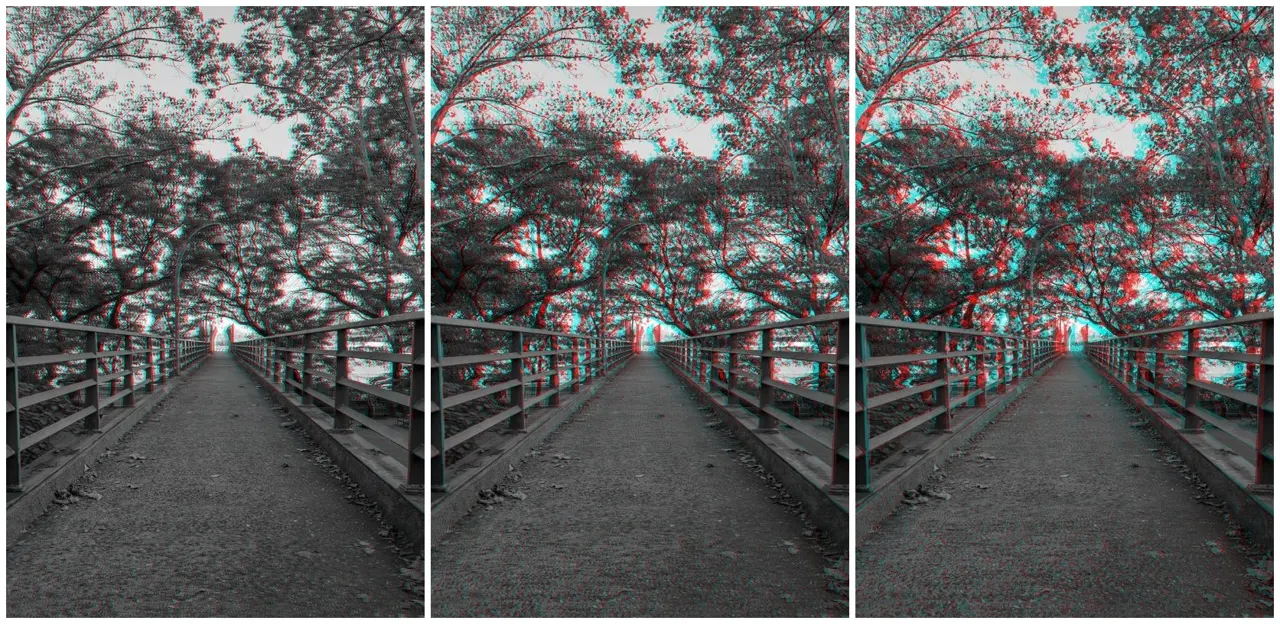
One photo, three 3D strengths, made by us with the depth model of our Photo to 3D tool. Red is the left-eye view, cyan the right-eye view. The wider the red and cyan edges, the harder your eyes must work. Photo: King of Hearts, CC BY-SA 4.0, via Wikimedia Commons.
Key takeaways
- The cause is a focus mismatch, and strong depth makes it worse. See why it happens.
- Eye strain or headaches every time? Eye doctors advise an eye exam. See is it my eyes.
- Next showing: passive glasses, a seat farther back, breaks. See what to change.
- At home you can choose gentler depth for your own videos. See 3D at home.
- Worried about a child, or a VR headset? See children or our VR motion sickness guide.
Why 3D films cause headaches
The light comes from the screen, so your eyes must focus there. At the same time, they must turn to the depth of the 3D object, in front of or behind the screen [4]. In real life, focus and eye angle always move together. A 3D film pulls them apart. A 2008 study says this split "frequently reduces one's ability to fuse the binocular stimulus and causes discomfort and fatigue for the viewer" [3].
The range in which this stays comfortable is small. The same study, citing earlier work, puts it at about one-third of the range in which you can still see one clear image [3]. Big depth pushes you out of it. In a test with 24 adults, the uncomfortable direction depended on distance. On a phone or desktop screen, depth in front of the screen was less comfortable. In a cinema, depth behind the screen was less comfortable [4].
The numbers show the difference between 2D and 3D. In a study of 497 adults, 54.8% reported some sickness after a 3D film, against 14.1% after a 2D film [5]. After the 3D film, almost every symptom on the list was more common, with eyestrain the strongest eye symptom [5].
How much depth is too much
We made the picture at the top to show what "more depth" does. The depth model of our Photo to 3D tool guessed how far away each part of one photo is.
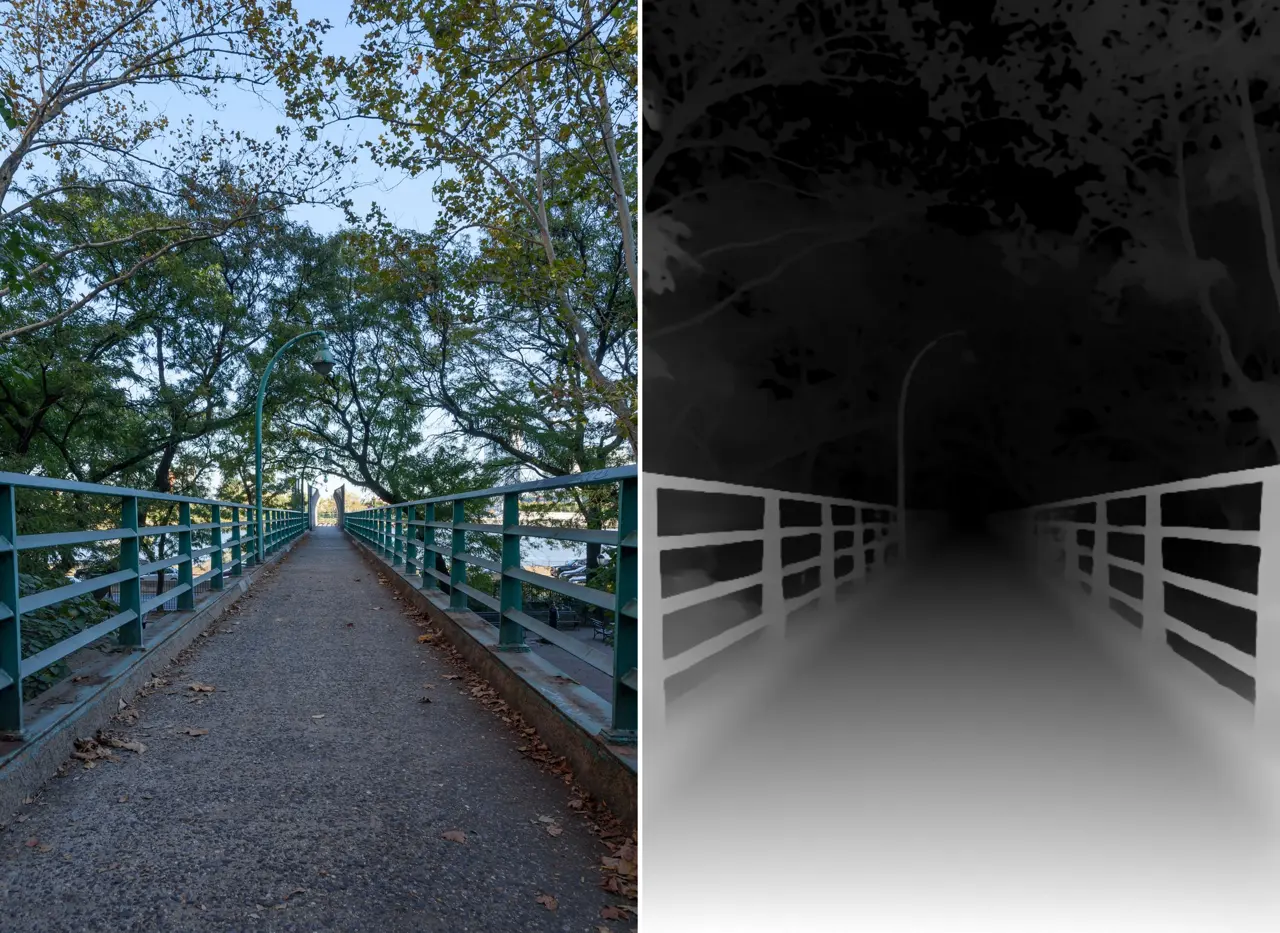
From the photo and the depth map, we made a left-eye and a right-eye view at three 3D strengths. Then we measured how far the nearest 1% and the farthest 1% of the 1,164-pixel-wide photo move between the two views:
| 3D strength | Near part moves | Far part moves | Total, as share of width |
|---|---|---|---|
| Low (0.015) | 8.1 px | 8.7 px | 1.44% |
| Tool default (0.03) | 16.2 px | 17.5 px | 2.89% |
| High (0.06) | 32.3 px | 34.9 px | 5.78% |
Each step up doubles the gap your eyes must bridge. A bigger gap pushes your eyes further out of the small comfort range described above [3].
Is it a sign that something is wrong with my eyes?
Sometimes, yes. The American Optometric Association (AOA) said in 2010 that "anywhere from three to nine million people have problems with binocular vision prohibiting them from watching 3-D TV and movies" [1]. An optometrist at the UK Association of Optometrists says: "Difficulty watching 3D films comfortably can be an early sign of visual problems" [2]. An optometrist quoted by the AOA names lazy eye, convergence insufficiency and poor focusing skills as problems that 3D can "unmask" [1].
The AOA advises an eye exam if you answer yes to any of these five questions [1]:
- "Is the 3-D viewing experience not as vivid as it is for others watching the same picture?"
- "Do you experience eyestrain or headaches during or after viewing?"
- "Do you feel nauseous or dizzy during or after viewing?"
- "Are you more comfortable viewing 2-D TV or movies instead of 3-D TV/movies?"
- "Is it difficult for your eyes to adjust back to normal after watching 3-D TV/movies?"
Our free stereo vision test shows how fine a depth difference your eyes can see. It is not an eye exam.
Who gets it more
- People with migraine. In an Estonian survey of 1,293 people, a history of migraine made a headache during or after a 3D film about 3.4 times as likely [7].
- Younger women. The same study names them as the main risk group, with people with migraine [7].
- People who get car sick or often have headaches. These were predictors of more symptoms in the 497-viewer study [5].
- Glasses wearers: no extra risk found. In the same study, glasses or contact lenses did not seem to raise the risk [5].
What to change at the next showing
- Pick a passive 3D showing and a seat farther back. For people with migraine and younger women, researchers recommend "passive 3D technology" and "the farthest possible distance" [7]. To choose a format, see which showing to book. The 907-viewer study found sitting close had "little and not significant effects" [6].
- Try an animated film first. In the 907-viewer study, animated 3D films seemed "protective for tired eyes" [6].
- Take breaks and stop when it hurts. For its 3DS, Nintendo advises a 10 to 15 minute break "every half hour when using the 3D feature" [8]. If you feel dizzy or sick, it says to stop and rest for several hours [8].
If 3D always hurts, the 2D showing is a fine choice.
What viewers report
Viewers' own accounts, not our tests:
- A film blogger watched Sanctum in IMAX 3D in Manhattan (February 2011) and "ended up with a dull headache that lasted some time after the credits ended". Her plan: "double-check my glasses for scratches and sit an extra five rows back from the screen" [11].
- A MacRumors member (June 2012): "One time at Avatar i was sat at front row and the 3D was headache inducing being so close to the screen." [12]
- A home theater writer's daughter got headaches from 3D films. He told her to keep her head level for Jurassic World in 3D (Fathers' Day 2015): "Result: no headache." [10]
- A viewer with a convergence disorder (May 2012): "I end up spending the whole movie with one eye closed." [13]
3D at home, with gentler depth
At home, you choose the depth. The Owl3D desktop app turns your own 2D videos and photos into 3D. Its 3D strength has five levels, from Subtle to Maximum. If strong 3D gives you a headache, pick Subtle or Gentle. It is an AI conversion, not the studio's 3D version.
The Owl3D Shift is a 3D monitor that needs no glasses. Its Live 3D converts what is on your screen to 3D instantly, and it has a Comfort depth preset. The focus mismatch is still there with any 3D screen [3], so take the same breaks.
From Owl3DOwl3D converterA desktop app for Windows and Mac that turns 2D videos and photos into 3D.Children and 3D films
The AOA says 3D in films and TV "isn't necessarily bad for adults or children". It also says studies on long 3D viewing by young children "remain to be done", so use in moderation is wise [9]. If a child has discomfort, dizziness or no sense of depth, the AOA says an eye exam is "crucial" [9]. Nintendo warns that the 3DS 3D feature is only for children 7 and over [8].
Headaches in a VR headset have their own causes and fixes: see VR motion sickness.
Frequently asked questions
Can 3D movies damage your eyes?
The AOA says 3D "isn't necessarily bad for adults or children" [9]. No source we read says 3D films damage adult eyes. The symptoms in the studies above were mostly short-term: in the 907-viewer study, 8.3% still had a headache 2 hours after the film [6].
Why do 3D movies make me dizzy?
Probably not from the 3D itself, says the researcher behind a UK lab study of 433 people [14]. Viewers who only thought they were watching 3D reported dizziness at about the same rate (3%). Real 3D mostly added headache or eyestrain, around 10% [14]. People with 3D vision problems are different: in an AOA survey, 11% of them reported dizziness [1]. If you feel dizzy, stop and rest [8].
Does it get better during the film?
For some people. The film blogger above wrote that "the worst subsided (or my eyes adjusted) within the first twenty minutes" [11]. If it does not, stop and rest [8].
Sources (14)
- American Optometric Association, press release "3-D TV and Movies Look to Attract Viewers But Not Everyone Can 'See' What All the Hype is About", PR Newswire, May 18, 2010. https://prnewswire.com/news-releases/3-d-tv-and-movies-look-to-attract-viewers-but-not-everyone-can-see-what-all-the-hype-is-about-94098309.html Opened 2026-11-28.
- Association of Optometrists (UK), "Look out for 3D film warning signs", April 14, 2016. https://www.aop.org.uk/campaigns-and-policy/news-and-media/aop-news/2016/04/14/look-out-for-3d-film-warning-signs Opened 2026-11-28.
- Hoffman, Girshick, Akeley and Banks, "Vergence–accommodation conflicts hinder visual performance and cause visual fatigue", Journal of Vision 8(3):33, 2008. https://pmc.ncbi.nlm.nih.gov/articles/PMC2879326/ Opened 2026-11-28.
- Association for Research in Vision and Ophthalmology, press release "Smartphone making your eyes tired?" on Shibata, Kim, Hoffman and Banks, "The Zone of Comfort: Predicting Visual Discomfort with Stereo Displays", Journal of Vision, 2011. https://eurekalert.org/news-releases/781576 Opened 2026-11-28.
- Solimini, "Are There Side Effects to Watching 3D Movies? A Prospective Crossover Observational Study on Visually Induced Motion Sickness", PLoS ONE 8(2): e56160, 2013. https://journals.plos.org/plosone/article?id=10.1371/journal.pone.0056160 Opened 2026-11-28.
- Solimini et al., "A survey of visually induced symptoms and associated factors in spectators of three dimensional stereoscopic movies", BMC Public Health 12:779, 2012. https://pmc.ncbi.nlm.nih.gov/articles/PMC3490878/ Opened 2026-11-28.
- Braschinsky et al., "3D Cinema and Headache: The First Evidential Relation and Analysis of Involved Factors", Frontiers in Neurology 7:30, 2016. https://pmc.ncbi.nlm.nih.gov/articles/PMC4803726/ Opened 2026-11-28.
- Nintendo Support, "Health & Safety Precautions: Nintendo 3DS". https://en-americas-support.nintendo.com/app/answers/detail/a_id/50336/ Opened 2026-11-28.
- News-Medical, "AOA says 3D viewing may help uncover vision disorders in children", January 6, 2011. https://www.news-medical.net/news/20110106/AOA-says-3D-viewing-may-help-uncover-vision-disorders-in-children.aspx Opened 2026-11-28.
- HomeTheaterHifi, JJ's Now-and-Then Blog, "How to Prevent Headaches When Watching 3-D Movies", July 1, 2015. https://hometheaterhifi.com/blogs/jj-s-now-and-then-blog-how-to-prevent-headaches-when-watching-3-d-movies/ Opened 2026-11-28.
- ScreenerBlog, "It finally happened to me: 3D sickness", February 2011. https://screenerblog.blogspot.com/2011/02/it-finally-happened-to-me-3d-sickness.html Opened 2026-11-28.
- MacRumors Forums, "3D gaming?", June 2012. https://forums.macrumors.com/threads/3d-gaming.1389454/ Opened 2026-11-28.
- Straight Dope Message Board, "I hate 3D movies", May 2012. https://boards.straightdope.com/t/621147 Opened 2026-11-28.
- Newcastle University press office, Jenny Read, "Do 3D films make you dizzy, or is it just your imagination?", July 2015. https://www.ncl.ac.uk/press/articles/archive/2015/07/do3dfilmsmakeyoudizzyorisitjustyourimagination.html Opened 2026-11-28.